Finding Your Dog's Agility Photo by Obstacle and Round Number
You're scrolling through your phone after a long weekend at an agility trial in Brisbane, and you remember exactly where your Border Collie flew over the tire jump in Round 7. The image is seared into your mind, but finding the actual photograph feels impossible. Between the early starts, the tail-wagging chaos of the warm-up ring, and the adrenaline of watching your dog navigate the course, it's easy to lose track of which image belongs to which round.
That's where Pawprint Pictures comes in. The site organises thousands of images into searchable galleries sorted by event, club, handler, and dog, which makes locating a specific shot far less painful than guessing. With a little detective work and a handful of details, you can usually track down that memorable moment without spending your whole evening scrolling through the agility photo galleries.
How agility event galleries are structured
Every trial generates an enormous volume of photographs. A single weekend at a club show in Adelaide might produce several thousand images across all rings, height classes, and rounds. Pawprint Pictures breaks that volume down into manageable chunks by event date and then by ring or judge assignment. Within each event, the gallery is further sorted by class, which often corresponds to height and experience level.
The site supports major sanctioning organisations including AKC, USDAA, NADAC, CPE, and ASCA. Many Australian clubs use these frameworks or local equivalents such as Dogs Australia for record-keeping, which means your photos will likely sit under a familiar umbrella regardless of where you trial. Knowing which organisation sanctioned the trial is the first clue, because it determines the naming convention used in the gallery folder.
Galleries are also split by club, which helps when multiple clubs co-host a larger event. A trial hosted jointly by a Melbourne-based club and a regional Victorian club, for example, will appear as two separate folders even though the rings ran side by side. Confirming the hosting club is often the difference between landing in the right gallery and wandering through the wrong one entirely.
Starting with the round number
The round number is your strongest search anchor. Almost every gallery on the platform is sorted sequentially, so narrowing your search to a specific round removes a huge slice of the catalogue in one step. If you remember Round 4 of the Jumpers class, you can filter to that round and ignore everything else from the day.
Australian trials often run several rounds in a single day, particularly at multi-day events held over long weekends tied to public holidays like the Queen's Birthday or Labour Day. A handler competing across Masters, Open, and Novice might rack up six or seven rounds before Sunday afternoon, which means precision matters. Jotting down the round number as soon as you leave the ring is a habit worth building.
If you're unsure whether the round was part of a combined class or a standalone, check the event schedule PDF that most clubs publish in advance. These schedules list each round, the judge, and the height groups, which provides a useful cross-reference when you're hunting through folders later.
Identifying the signature obstacle
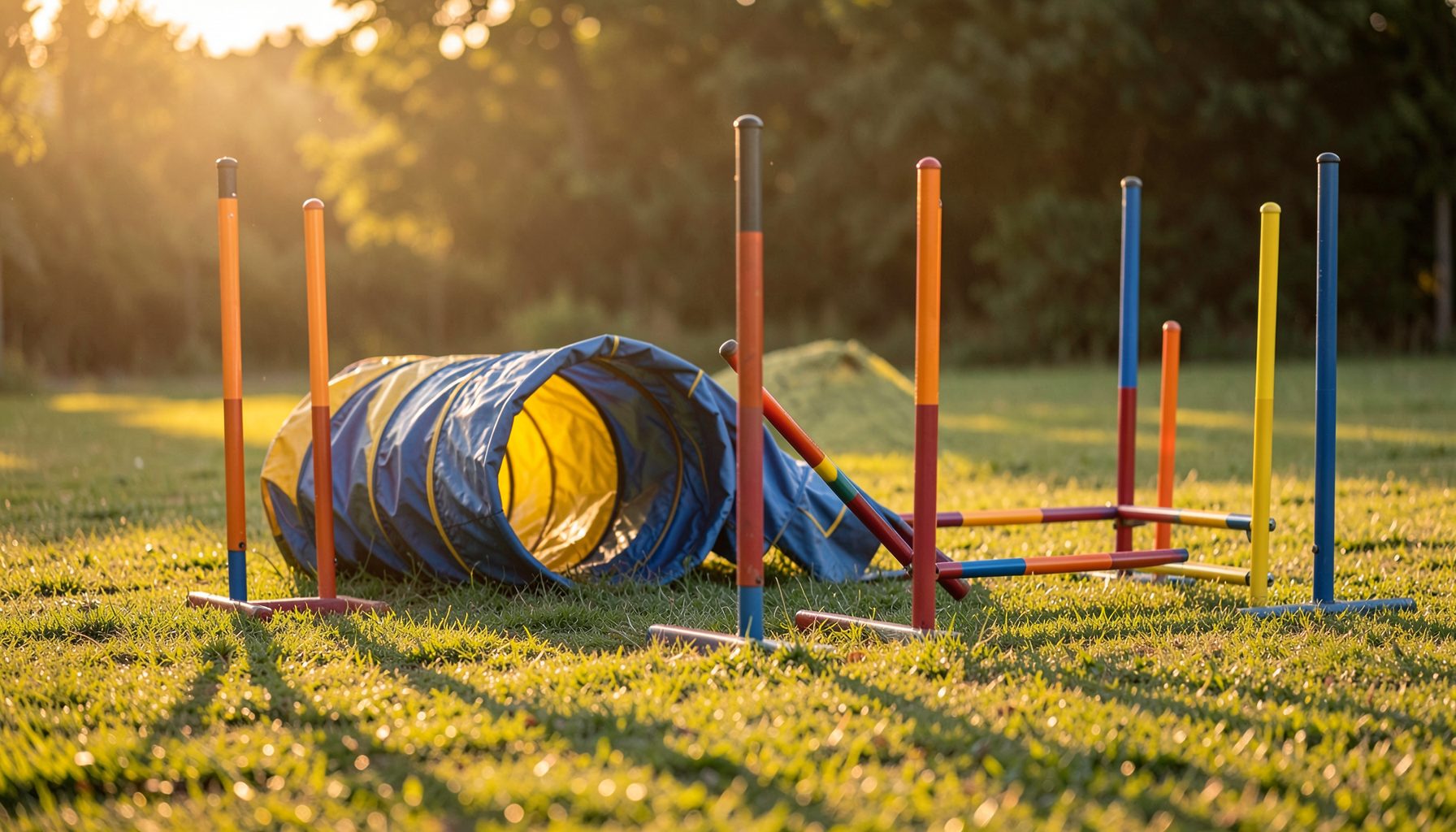
When the round number alone isn't enough, the obstacle you remember becomes the next layer of detail. Think about the obstacle that stood out: was it a tricky A-frame at the far end of the course, a set of twelve weave poles, or the teeter totter near the exit? Photographers tend to cluster shots around the more dramatic obstacles because that's where handlers and dogs look most engaged.
In Australian outdoor venues, lighting and backdrop often make certain obstacles more photogenic. A dog walk set against a gum tree or a tunnel exit framed by afternoon light tends to attract the camera more than a plain bar in the shade. If you remember the surrounding scenery as much as the obstacle itself, that visual cue can help you spot the right series in the thumbnail strip.
Course maps are typically available from the judge's table or the club secretary on the day. These maps include obstacle numbers, which most photographers use to label their images. A photo marked "Obstacle 5" or "Weaves" usually corresponds to the labelled position on that map, so matching your memory to the map is a reliable shortcut.
Using course maps and judge briefs
Course maps are the unsung hero of photo retrieval. Most judges post a sketch of the course before the walk-through, and clubs in places like Perth and Sydney often share these maps in their member portals or Facebook groups within hours of the event finishing. Holding onto that map, even as a screenshot, gives you obstacle numbers and flow patterns to work with.
Photographers at larger events sometimes number their image filenames sequentially through the round, which loosely tracks the order dogs encountered each obstacle. If your round started with a pinwheel of jumps and ended at the contacts, the photos will probably follow that sequence. Recognising the order helps you flip through a thumbnail strip quickly rather than inspecting every image.
Judge briefs and ring layouts also reveal where the photographer was stationed for that round. A photographer positioned near obstacle 9 will have a dense cluster of shots from that angle, while obstacles further away will appear smaller or from a different vantage. Matching your mental image of the background to the camera position confirms you've found the right batch.
Searching by handler and dog names
Once you've narrowed down the round and the likely obstacle cluster, the handler and dog name search becomes the finishing touch. Pawprint Pictures lets you look up galleries by handler surname and registered dog name, which is especially helpful at events with dozens of competitors in the same height class. If your kennel name appears on the dog's entry, search for that prefix as well.
Australian agility databases often include both the call name and the registered name, and photographers typically caption images using whatever appears on the run order. If your dog competes as "Dash" at home but is registered as "Aussie Dash Lightning," either spelling might appear in the gallery. Searching both variations avoids the frustration of assuming the caption uses one or the other.
For handlers with multiple dogs competing at the same trial, the site separates entries by dog. This means you won't accidentally view photos of your older Labrador while hunting for your young Kelpie's round. Checking each dog's individual folder ensures the photo you purchase is the one you actually want printed.
Reaching out for help
Sometimes the gallery structure alone isn't enough, and that's when a direct message to the photographer closes the gap. Pawprint Pictures runs a support contact form on every event page, and the team is used to handling requests that come down to "round with the weave poles, near the end of the day." The more detail you provide, the faster they can pull the right file.
A useful message includes the event name, the date, your height class, the round number, and a description of the obstacle or background you remember. Mentioning which organisation sanctioned the trial helps the team locate the right folder quickly. A friendly tone goes a long way, especially during busy periods when multiple trials happen on the same weekend across Queensland, Victoria, and Western Australia.
The team regularly fields requests from handlers who remember only fragments, such as "the dog in the blue collar near the A-frame" or "my sister's kelpie, second round of the afternoon." With a rough timestamp and the event name, they can usually pinpoint the right series within minutes. Most Australian handlers carry proof of council registration and vaccination in their vehicles, so having those details handy speeds up any cross-reference the photographer might need.
Smart habits for future searches
A few practical habits turn a long scroll into a quick lookup. Before the trial begins, prepare your phone, notebook, and memory for the small details you'll thank yourself for later.
- Screenshot the course map and judge brief on the morning of the trial, before your phone battery drains in the sun.
- Write your round number, ring, and height class in a notes app the moment you leave the ring.
- Photograph the run order posted near the judge's table so you have handler names and dog names on hand.
- Note the photographer's station on the course so you can match the angle in your memory to a thumbnail strip later.
- Save your gallery links in a folder labelled by month and venue for easy retrieval.
- Cross-check your dog's registered name and call name when searching, since either could appear in captions.
The simplest habit is also the most effective: keep your run order and a fresh battery in your camera bag. When the round ends and your dog is still buzzing from the weaves, take ten seconds to type "Round 5, twelve weaves, sunny side" into your phone, and consider booking a professional portrait session at your next event. Months later, those notes will bring back the image without a long scroll, whether you're trialling in Sydney, Perth, or a regional ground in rural South Australia.