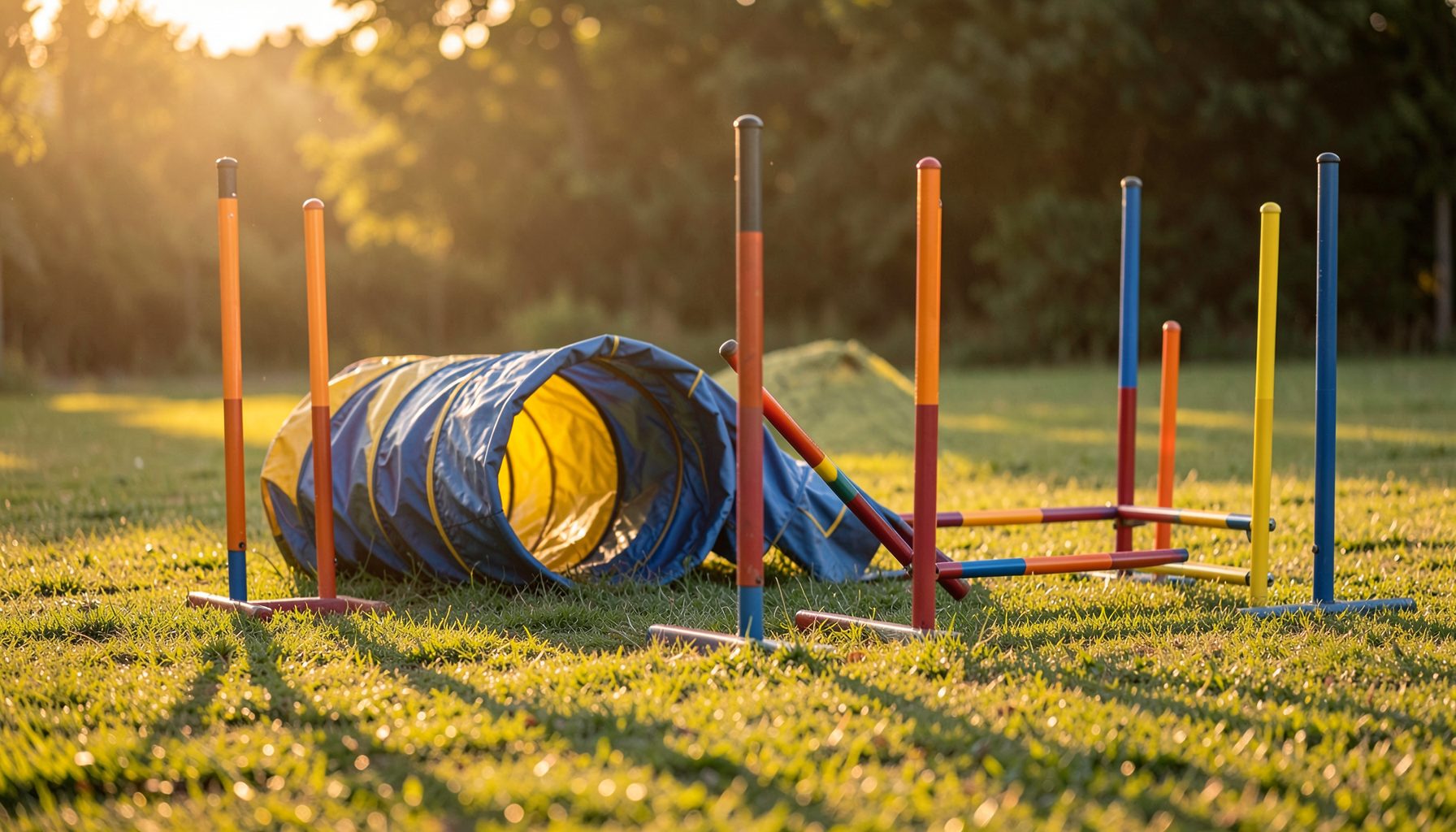
Catching your dog's eye contact through the weave poles
Weave poles are the most visually intricate obstacle on an agility course. Twelve uprights spaced around 600 millimetres apart, they ask the dog to thread a precise line while the handler stays out of its path. For a photographer, the result is a forest of vertical poles with only narrow sightlines to the canine athlete. The goal is to freeze the moment when the dog glances up, locks onto the handler, and carries that connection through.
Handlers across Australia often talk about "the look" — that split second of partnership that separates a polished run from a fumbling one. A strong weave-pole portrait is less about luck than about placing yourself where the dog's gaze, the handler's face, and the camera's focal plane all line up cleanly. Capturing it takes equal parts geometry, gear knowledge, and patience with the dog.
Photographers working at Australian agility trials develop routines around this challenge. From early morning events hosted by ANKC-affiliated clubs to weekend shows at suburban grounds, the question is the same: how do you actually photograph a dog looking through the poles at its handler?
Reading the geometry before pressing the shutter
Every weave-pole entry follows a predictable line. Most handlers send their dogs in at a 45-degree angle, so the gaze — and the moment of eye contact — happens around poles three through seven. Photographers who read that angle can stand on the opposite side of the course, looking back along the dog's line of approach.
Standing waist-high rather than crouched works best. A slightly elevated position catches the whites of the eyes, the shape of the ears, and a flash of tongue against the green or blue pole bases common at Australian trials. The dog's head tilts up and forward during the entry, so aiming for the upper third of the frame keeps the eyes close to a strong compositional point.
The handler's body language is part of the geometry too. A handler who calls the dog's name mid-weave often turns the torso toward the entry point, and the dog's gaze follows that motion. Photographers who read the shoulders in advance cut down on missed frames and pick a position before the run begins.
| Setting | Recommended value | Reasoning |
|---|---|---|
| Shutter speed | 1/1600 s or faster | Freezes weave-pole paw flicks and ear motion |
| Aperture | f/2.8 to f/4 | Blurs nearby poles while keeping the eyes sharp |
| ISO | 800 to 3200 | Keeps shadow detail under tree cover at afternoon trials |
| Autofocus | Continuous eye-detection or wide tracking | Holds the gaze when poles briefly obscure the face |
| Burst mode | High-speed continuous | Increases the odds of catching the exact glance upward |
Camera settings that survive weave-pole speed
A medium-sized working dog passes through twelve poles in roughly two to three seconds. Inside that window the photographer needs shutter speed fast enough to freeze paw flick-outs, an aperture wide enough to blur foreground poles, and an autofocus mode that tracks a moving face through vertical obstacles.
Most modern mirrorless bodies offer subject-detection autofocus trained on animal eyes, which has changed weave-pole work considerably. The system hunts through momentary gaps between poles and locks on as soon as the face appears. Older DSLR bodies rely on manual single-point focus placed where the head will be, prefocused during the practice walk-throughs ANKC-affiliated clubs usually run before a trial.
Lens choice matters too. A 70-200mm f/2.8 lets the photographer stand a safe distance back from the course — important at crowded events such as the Sydney Royal Easter Show, where spectators press close to the rings. A prime 135mm or 200mm offers sharper results for the photographer with a fixed shooting lane.
Positioning through the line of poles
The weave poles are a series of narrow gaps, not a solid wall. The gaps between alternating poles are roughly the width of a dog's muzzle, which is just wide enough to shoot through when the angle is right. The clearest sightline is usually on the side of the weave entry, angled about 30 degrees from the dog's direction of travel.
Shooting straight on compresses the dog's face behind layers of plastic. Shooting from the side at a 30-degree offset opens a corridor where the eyes, the handler's face, and the camera all line up. This is the geometry handlers at Melbourne Royal trials comment on when reviewing their galleries, because the photograph finally shows the connection they feel on course.
Once the run begins, the photographer must hold still. Tripods are generally not allowed inside Australian agility rings for safety reasons, so a monopod, a beanbag on the ring rail, or simply bracing the lens against a knee helps stabilise a long lens. Clubs typically invite photographers into specific zones around the ring, and Pawprint Pictures outlines those zones on its club shows and trials page. The photographer's job in the last two seconds before the dog enters the weave is to confirm focus, lock exposure, and wait for the eyes.
Timing the glance at peak attention
The glance happens in a fraction of a second. For most dogs the head lifts between poles four and six, the moment when the dog is committed to the entry but still checking that the handler's path matches. Experienced photographers time the shutter release to the smallest movement of the ears, since ear position changes about a tenth of a second before the eyes rotate up.
Burst mode helps, but pre-visualisation matters more. A photographer who has watched the handler and dog in earlier runs already knows which pole the dog looks up at, turning a guess into a plan. Many handlers browsing their photo galleries find that their favourite weave-pole shots are taken on the second or third run of the day, when the dog is warmed up and the handler's cues are settled.
Light plays into timing as well. Midday sun overhead turns the inside of the weave poles into harsh shadow. Late afternoon casts a warm side light that catches the eyes and adds a catchlight. Cloud cover, frequent during spring trials, softens everything and gives the photographer an extra second of usable eye contact.
Working with Australian conditions and clubs
Australian agility runs outdoors most of the year, so photographers contend with bright sun and the occasional coastal wind. Lens hoods help with flare during morning runs at coastal clubs in places like the Mornington Peninsula. A microfibre cloth in the pocket is not optional; sea spray and dust find their way onto front elements.
Local clubs invite photographers to set up at specific zones around the ring. Respecting these zones keeps the photographer safe from a fast dog and out of the judge's sightline.
Australian handlers sometimes gather their team to review images together. A club photo review session works well, and Pawprint Pictures has written a step-by-step guide on running a photo review that explains the logistics. Pairing the review with a chat about weave-pole handling helps handlers pick images that show real connection rather than just a clean pole exit.
Field habits that strengthen a weave-pole gallery:
- Arrive an hour before the trial starts and walk the ring to mark the weave-pole entry angle.
- Prefocus on a chosen pole and lock exposure during the handler's practice run.
- Keep both eyes open while shooting to track the dog's approach without losing peripheral awareness.
- Use a monopod or knee brace for stability, since handholding a 200mm lens through twelve poles tires the arms fast.
- Shoot at f/4 when the foreground poles are too dense at f/2.8, and accept slightly less background blur.
- Flag the best eye-contact frames in a folder the same day, while the details of the run are fresh.
- Charge batteries and clear cards between events; Australian summer heat shortens battery life more than expected.
A weave-pole photograph that catches a dog's focused gaze is a small record of a partnership built over months of training. The image holds the line of sight between handler and dog, the rhythm of the run, and the conditions of the day. Years later, after the dog has retired and the handler is coaching the next young dog through the same poles, that photograph still tells the truth of what they built together.