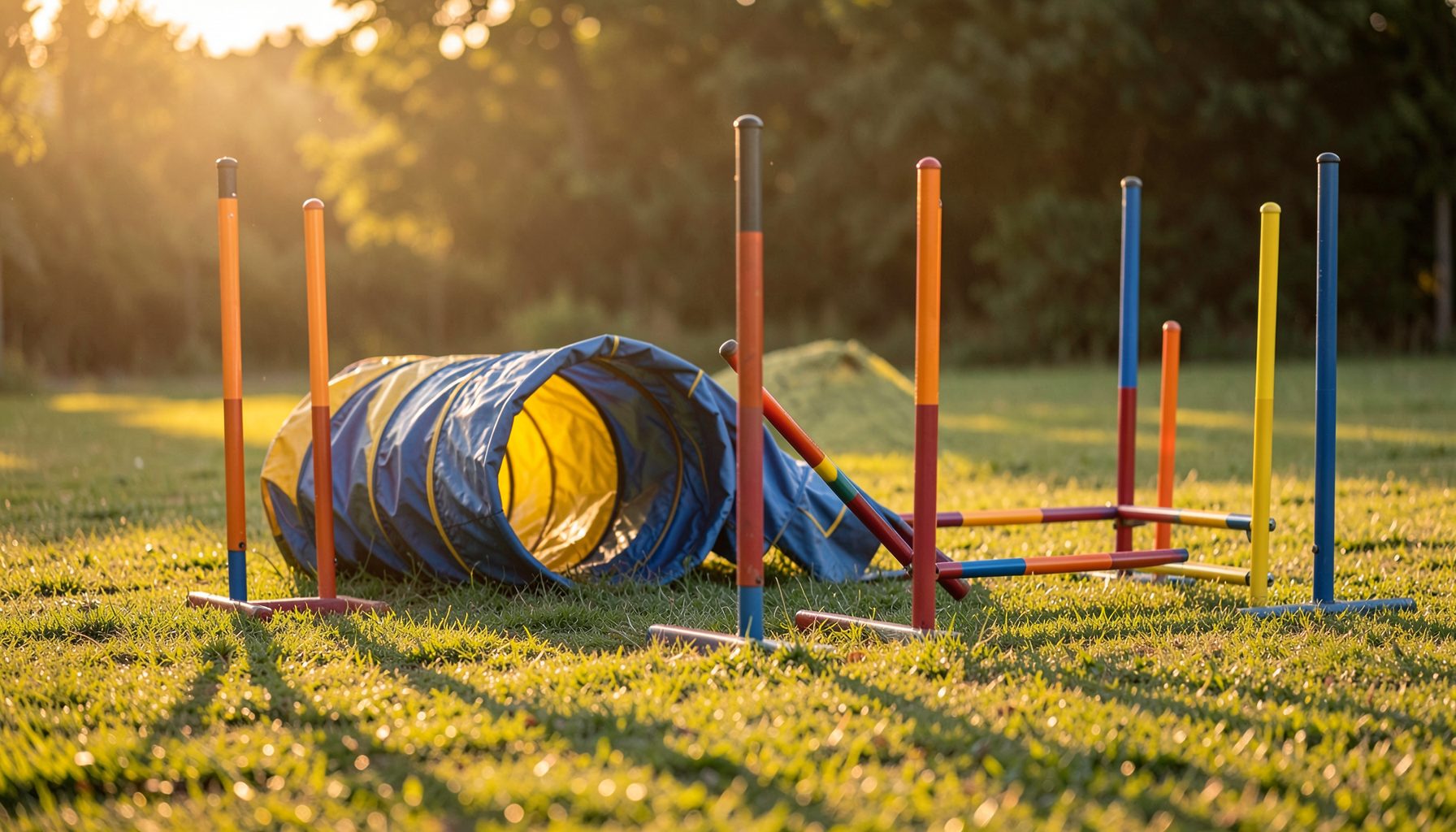
The Split Second Behind a Remarkable Tunnel-to-Weave Photo
Some agility photographs are technically sharp, well composed and nicely timed. A few go further. They preserve the instant when a run seems to change direction in mid-air, capturing the dog’s power, the handler’s concentration and the course’s demands in one frame.
The most dramatic tunnel-to-weave transition in our collection came from a run that looked almost too fast to photograph. The dog burst from the tunnel with its body still carrying the curve of the entry, then snapped towards the weave poles while the handler moved into position. For a fraction of a second, every part of the performance appeared to be pulling in a different direction.
That tension is what makes the image memorable. It is more than a record of a clear obstacle sequence. It tells the story of trust, timing and communication that sits behind competitive dog agility, whether the event is held on a Canberra oval, a Melbourne showground or a club field outside Brisbane.
The Course Created the Drama
Tunnel-to-weave transitions are visually demanding because the dog exits one obstacle at speed and immediately has to find a precise entry to another. A tunnel can hide the dog’s approach, leaving the photographer with very little warning. The weave poles then require accuracy, rhythm and commitment rather than simple forward motion.
In this particular sequence, the tunnel exit faced across the photographer’s angle rather than directly towards it. That created a layered composition: the dark tunnel mouth framed the dog’s shoulders, the handler appeared just beyond the line of travel, and the poles formed a repeating pattern into the background.
The course designer had effectively built a visual question into the run. Could the dog maintain momentum while reading the handler’s cue? The answer was visible in the dog’s posture: head turned towards the first pole, front feet reaching, hindquarters still unwinding from the tunnel.
Timing Had to Beat Speed
A camera can shoot many frames per second, but fast equipment does not automatically produce a meaningful agility photograph. The photographer must anticipate the dog’s line, understand the handler’s movement and choose a position that reveals the decision being made.
The decisive frame arrived between two more obvious moments. One frame showed the dog still inside the tunnel, hidden from view. The next showed a clean weave entry already underway. The selected image caught the transition itself, with the dog suspended between acceleration and precision.
That is why the photograph feels almost impossible to hold still. The dog’s muscles are engaged, the coat is lifted by movement and the handler’s shoulders indicate the next instruction. It has the visual energy of a jump photograph, but the technical story is different: this is a picture about redirection.
At a trial in Australia, that instant can be especially fleeting when the ground is firm, the light is harsh and runs are scheduled tightly through the morning. A photographer may have only one attempt before the next dog is called, with competitors, ring crew and equipment constantly changing the available viewpoint.
The Handler Is Part of the Picture
The dog is the natural focus, yet the handler gives this image much of its emotional charge. Their position shows how the cue travelled through the sequence. A small change in shoulder angle, arm position or stride can help the dog understand where to go next.
In the selected frame, the handler is neither posing nor looking at the camera. Their attention is entirely on the dog. That unguarded concentration makes the photograph feel authentic. It shows the partnership as it happens, rather than presenting a polished portrait away from the ring.
Australian handlers will recognise that feeling from long trial days, whether they are running at Dogs NSW events near Sydney, travelling to a Dogs Victoria fixture around Kyneton or setting up early for a Queensland club competition. The language may be casual—“good girl”, “steady”, “come on”—but the communication between dog and person is highly practised.
The best action images preserve that relationship without distracting from the performance. In this case, the handler’s movement leads the eye from the tunnel to the dog and then into the weave poles, giving the image a natural visual path.
From a Single Frame to a Customer Gallery
Once the event was finished, the photograph still had to be identified, checked and placed where the right person could find it. Agility galleries often need to be organised by event, club, handler and dog name because a single day may contain hundreds of runs and multiple rings.
That organisation matters to Australian customers who may be searching after travelling home from a trial in Adelaide, Perth or Canberra. A handler might remember the approximate class and obstacle sequence but not the photographer’s frame number. Clear gallery labels and reliable search details turn a striking image into something practical to locate.
For owners checking whether their run was captured, the customer galleries area provides a direct route to event photographs and ordering information. The image can then be considered alongside other frames from the same run, including a tunnel entry, a weave completion or the finish-line celebration.
The original file also goes through selection and quality checks. Focus, expression, body position and background distractions all influence whether an action frame belongs in the final gallery. A technically acceptable photograph may be left out if it does not explain what was happening on the course.
Why This Frame Stayed With Us
Many agility images show speed. Fewer show the instant when speed has to become accuracy. This one stayed in the collection because it combines both: the dog is moving with extraordinary force, yet the photograph is about control.
It also works at several distances. Viewed quickly, it is an energetic action shot. Look longer and the details emerge—the dog’s eyes finding the entry, the handler’s cue, the tunnel’s curve and the poles waiting to test the next decision. That layered reading gives the image lasting value as a print or wall display.
When comparing photo products across different organisations, event formats and ordering systems, it helps to understand how packages and individual images can vary; our pricing comparison explains some of those differences. For Australian buyers, the final choice may also involve AUD pricing, delivery to a regional address or deciding between a digital file and a physical print.
Details Worth Looking For in an Agility Action Photo
- A clear view of the dog’s eyes and intended line
- Body position that shows acceleration, collection or redirection
- Handler movement that explains the cue without overpowering the dog
- Course features that establish the challenge, such as tunnels and weave poles
- A clean enough background for the image to work as a print
- Timing that captures a decision rather than an ordinary stride
The dramatic quality of this tunnel-to-weave transition came from several elements arriving together: the course layout, the dog’s athletic response, the handler’s precise movement and a camera shutter released at exactly the right moment. Remove any one of them and the frame becomes less revealing.
That is what makes event photography valuable to people who train every week and compete across Australia. A result sheet records faults, times and placings. A well-timed photograph records how the run felt—the burst from the tunnel, the split-second choice and the partnership that made the next obstacle possible.
The image to remember is not simply the one with the most motion. It is the frame that lets you see the decision happening.