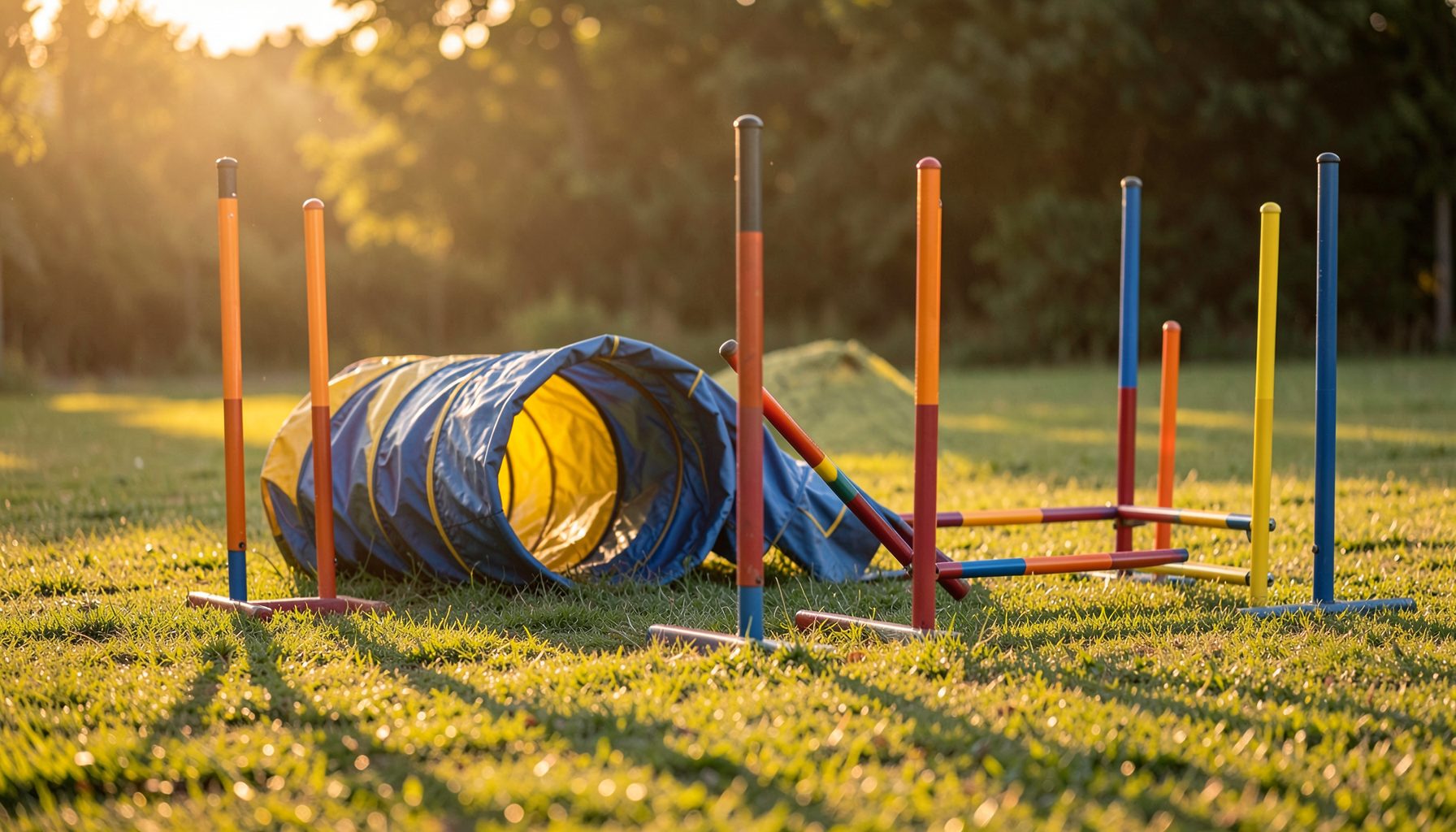
Why Sunset Silhouettes Belong on Canvas
A dog’s silhouette shot at sunset has a rare visual strength: it reduces a busy agility scene to shape, movement and light. The jump, the handler’s gesture and the dog’s lifted ears become instantly readable, creating an image that feels graphic while still holding the excitement of the run. That is why this kind of frame is often our editors’ favourite choice for canvas.
For Australian dog owners, it can also preserve a very specific memory: a cool evening trial outside Melbourne, a golden-hour training session near Sydney, or the last run of a long weekend show. Printed large, the image becomes more than event coverage. It becomes a quiet piece of sporting artwork with the dog’s personality still visible in its outline.
The Shape That Tells the Story
A strong silhouette captures the dog’s identity without relying on facial detail. The pricked ears of a kelpie, the feathered outline of a Shetland Sheepdog or the compact shape of a Jack Russell can all remain recognisable when the subject is almost entirely dark. Body position does the rest, showing drive, balance and confidence in a single instant.
Agility is especially suited to this treatment because the sport is built around expressive shapes. A dog stretched over a jump, gathered before a contact obstacle or turning sharply towards the next obstacle creates a clean visual rhythm. The handler’s line often adds a second shape, linking the dog to the decision-making and teamwork behind the performance.
Sunset Light Turns Motion Into Design
At sunset, warm backlighting separates the subject from the background and gives the edges a subtle glow. This rim light can pick out a tail, collar, whiskers or the top of a jump bar without weakening the boldness of the silhouette. The result has depth, even when the main subject appears almost black.
Australian locations offer plenty of opportunities for this effect. Low light across a Queensland grounds can look rich and amber, while a South Australian winter evening may create crisp, cooler edges. Coastal venues near Perth or Newcastle can add open sky and a broader horizon, giving the dog’s outline room to breathe.
The best frame usually includes enough sky or softly lit ground to provide contrast. A cluttered fence line, parked vehicle or crowded ring can compete with the subject, whereas a simple background allows the action to read immediately.
Why Canvas Suits a Silhouette
Canvas has a tactile surface that complements the painterly quality of sunset colour. It softens tiny details while preserving the major elements editors care about: the dog’s profile, the handler’s posture and the sweep of the light. That makes it especially effective for a large wall print viewed from across a room.
A canvas print also avoids the overly reflective finish that can distract from a dark subject. In a bright Australian home, where afternoon sun may enter through wide windows or verandas, a lower-glare surface can make the image easier to enjoy throughout the day. The woven texture adds warmth without making the photograph feel artificial.
Colour management remains important. Deep shadows should retain enough tonal variation to show the dog’s outline, while the sky should stay rich rather than becoming a flat orange block. Before ordering, customers should also review the crop and edge wrap so that ears, paws, tails and jump bars are not placed too close to the frame.
Choosing the Right Agility Frame
Not every sunset image is a good canvas candidate. Editors look for a decisive moment, a clean outline and enough resolution for the intended size. A dog caught between phases of movement may appear awkward, while a frame taken at full extension can communicate speed and purpose at once.
The relationship between dog and obstacle matters as well. A jump bar crossing the silhouette may add context, but it should not cut through the head or obscure the body. Contact equipment, weave poles and tunnels can create strong repeating patterns when the dog is positioned clearly against the light.
For owners searching through event galleries, filtering by handler and dog name is useful because a single run may produce several similar frames. The strongest option is often not the first image in sequence. It may be the frame immediately before landing, when the posture is most balanced and the outline is easiest to read.
The Details That Make a Print Ready
A professional sports photograph needs careful preparation before it becomes wall art. Editors assess focus, horizon placement, colour separation and the amount of negative space around the action. They also consider whether the image will look convincing at a larger scale rather than judging it only as a small screen preview.
Customer information and ordering details should be handled carefully during the purchase process. Pawprint Pictures explains how personal information is managed in its privacy policy, which is relevant when owners create accounts, search galleries or place orders for photographic products.
The final choice should suit the room as well as the dog. A panoramic crop can work above a sofa or along a hallway, while a vertical composition may suit a narrow wall near a home office. A generous border of sky can make an energetic image feel calm and balanced.
What Editors Look For in a Favourite Frame
The selection process begins with visual clarity. A successful silhouette should be recognisable in a thumbnail but rewarding at full size, with enough atmosphere to hold attention after the first glance.
Useful signs of a strong candidate include:
- A distinct outline of the dog’s head, back and legs
- Clear separation between the dog, obstacle and horizon
- A decisive moment that shows speed or concentration
- Warm, controlled colour in the sunset sky
- Sufficient space for cropping and canvas wrapping
Editors then consider how the photograph will function as a finished object. A dramatic action frame may suit a large living-room canvas, while a quieter profile could be better for a study, entryway or collection of smaller prints.
For that decision, it helps to compare:
- The dog’s posture with the direction of movement
- The amount of background detail around the subject
- The balance of dark tones and glowing sky
- The likely viewing distance in the chosen room
- Whether the composition reflects the dog’s personality
The most successful image usually combines technical quality with emotional truth. It should feel unmistakably like that dog, that run and that evening, rather than a generic sports photograph.
Matching the Image to the Finished Product
Different products emphasise different qualities in an agility photograph. Canvas is often the strongest choice for a bold silhouette because its scale and texture support the image’s graphic structure. A smaller print may preserve fine detail more sharply, while a framed photograph can suit a formal interior.
| Product | Best suited to | Visual strength | Placement idea |
|---|---|---|---|
| Canvas print | Bold silhouette and sunset colour | Soft texture and low-glare impact | Living room, hallway or home office |
| Framed print | Detailed action and equipment | Crisp definition and polished finish | Study, gallery wall or entry |
| Standard photographic print | Smaller images or albums | Fine detail and easy storage | Desk, shelf or scrapbook |
| Enlarged wall print | Strong negative space and clear focus | Immediate visual presence | Large open wall or training room |
The image can also carry the memory of a particular competition season. Owners who follow the Pawprint Pictures annual events listings can revisit photographs from club shows, trials and training days across the calendar, including events connected with AKC, USDAA, NADAC, CPE and ASCA communities.
For Australian handlers, that continuity matters. A canvas may recall a first pass at a local club, a qualifying run at a major weekend event or a familiar training ground shared with friends. The setting can change from Brisbane to Canberra or Adelaide, but the visual language of partnership remains the same.
A sunset silhouette works on canvas because it gives the eye exactly what a wall-sized image needs: a clear subject, confident movement and memorable colour. When the outline is clean and the moment is genuine, the photograph becomes a lasting reminder of the dog’s energy and the team’s connection. What readers should remember is that the best canvas image is the frame where shape, light and emotion all arrive together.