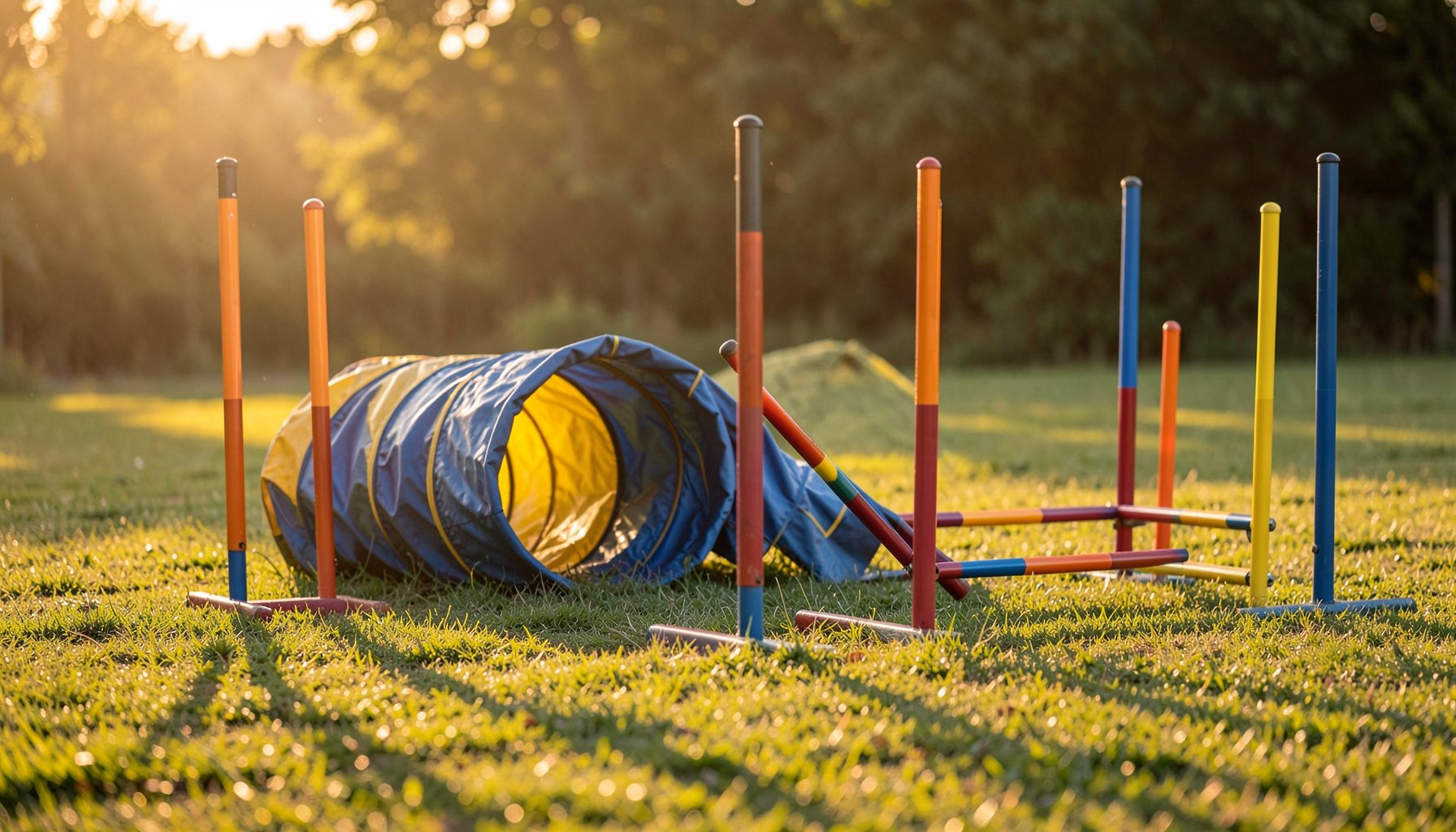
Why a nose-to-weave agility shot makes memorable wall art
At agility events, the strongest images often show a dog stretched over a jump, disappearing into a tunnel or turning tightly beside its handler. A shot of the dog’s nose touching the weaves feels more intimate. The obstacle becomes a threshold, the muzzle meets the vertical poles, and a fleeting training action becomes a portrait of curiosity, trust and timing.
A wide action frame records achievement; a close nose-to-weave frame reveals character. Fur, whiskers, shadow and striped poles create rich texture, while the exact point of contact gives the eye somewhere to rest. The picture can hold both energy and stillness, which is why it works as a unique wall piece rather than simply another event photograph.
Getting that instant requires technical control. The photographer must hold focus through fast lateral movement, preserve expression and catch a precise relationship between dog and obstacle. Arriving a fraction early leaves the nose short of the weave; waiting a fraction too long loses the contact.
For Australian homes, the finished photograph also needs to cope with bright sun, coastal glare, compact living areas and walls that are not always neutral. Crop, scale and finish determine whether the image becomes part of daily life or remains a digital file forgotten on a phone.
A small moment with strong visual pull
The weave sequence gives a photographer a clean graphic subject without losing the dog’s personality. Each pole creates a vertical line, and the moving muzzle interrupts that pattern at the decisive instant. That contrast lets the image work almost like a candid street photograph: part abstract pattern, part animal portrait.
The moment also carries narrative without needing a caption. The viewer can imagine the drive that brought the dog to the obstacle, the handler’s timing and the training behind the run. A guide to dramatic action at obstacles explains why particular agility furniture produces expressive frames, giving useful context for choosing both the viewpoint and the crop.
For a wall, the strongest treatment often preserves a little more space around the contact point. The nose should be visually dominant, yet some weave poles and the direction of travel should remain legible. Tightening the crop can increase drama; leaving room around it lets the viewer feel the speed that came before the pause.
The craft behind a convincing action portrait
Sharp action photography depends on anticipation as much as equipment. A shutter speed around 1/1000 to 1/2000 second, continuous autofocus, burst shooting and a well-positioned lens can preserve whiskers and fur instead of turning the muzzle into blur. Focus may sit on the nearest eye or the nose-to-pole contact, depending on the frame’s intended emphasis.
Timing matters even more with quick, clever breeds. The advice on sharp Border Collie action is particularly useful for a dog whose head changes direction abruptly between obstacles. The photographer must begin the burst before the nose reaches the weave, then select the frame that feels alive without looking artificially posed.
Australian daylight adds another challenge. Harsh midday sun creates deep shadows and squinting, while hot grass or synthetic flooring can make a dog tire quickly. Early mornings, late afternoons and open shade often produce softer light, but heat still calls for short sessions, water breaks and a change of plan when the dog’s attention fades.
Australian agility life and responsible photography
Australian everyday dog life often moves between suburban backyards, council-managed off-leash areas and club or trial grounds. Melbourne, Sydney and Brisbane have active agility communities, yet leash limits, restricted zones and registration requirements differ by local council. Photographers should use approved venues or permitted public spaces and respect each organiser’s access rules.
State and territory animal-welfare laws also shape responsible shooting. A dog should never be pushed to repeat a run if it is reluctant, lame or distracted. Vets note that discomfort can be well disguised in pets; a guide to recognising hidden pain in cats describes the same need to watch for protected shoulders, paws or posture. An image is not worth compromising an animal’s wellbeing.
Pawprint Pictures reflects the way many Australian dog owners now search for memories: photographs are organised by event, club, handler and dog across AKC, USDAA, NADAC, CPE and ASCA galleries, with prints and photo products available through a secure cart. This model suits a local market that values both organised dog sport and personalised home décor.
Australian consumer and copyright rules deserve attention at purchase. Consumer-facing prices should show GST clearly, and a secure checkout should make the total, delivery terms and product type easy to understand before payment. Buying a physical print normally grants the right to display that image; ownership of the photograph or permission for broad commercial reuse remains separate unless the seller’s terms state otherwise.
A practical checklist for choosing the wall piece
A good wall print gives the weave sequence room to breathe. Matte canvas emphasises fur and shadows, metal creates a crisp contemporary surface, acrylic adds depth and gloss, and framed paper suits a softer traditional interior. Exploring custom print finishes can show how the same crop changes across surfaces, tones and proportions.
Australian homes frequently use standard A-series dimensions, so A3, A2 and A1 sizes can simplify framing and replacement decisions. For a smaller wall, the image may be more striking at an intimate crop; for a lounge room, a larger panoramic frame can retain the poles and the dog’s forward momentum. Leave a little empty wall around an oversized piece so it feels deliberate.
Before ordering, several practical checks are worth making:
- Select a high-resolution frame where the nose-to-weave contact is clearly visible and no crucial expression has been clipped.
- Match size to viewing distance: A3 for a desk, A2 for a medium wall, and A1 or larger for a room-scale feature.
- Choose the finish for the room, considering matte texture, reflections, colour depth and the strength of the pole pattern.
- Add a mat or border when the crop is busy, giving the eye a calmer edge around the muzzle.
- Confirm wall measurements, hanging hardware, delivery details and UV protection before placing the order.
From event gallery to a lasting display
Finding the right photograph is straightforward when a gallery can be searched by the same details used on the day. Identifying the event, club, handler and dog helps connect the chosen frame with its context, while a high-resolution version provides enough detail for cropping without loss of quality.
Display should also account for Australian conditions. UV-filtering glazing or acrylic helps limit fading in strong sun, while a stable hanging point and moisture-resistant fixings protect the print in humid rooms or coastal homes. Avoid framing with acidic or untreated backing materials, and keep the finished piece away from damp walls and direct afternoon sun.
The practical takeaway is to choose the frame that still feels vivid at a distance of one metre, then print it at a size and finish that let the nose, fur and weave tell the story together.