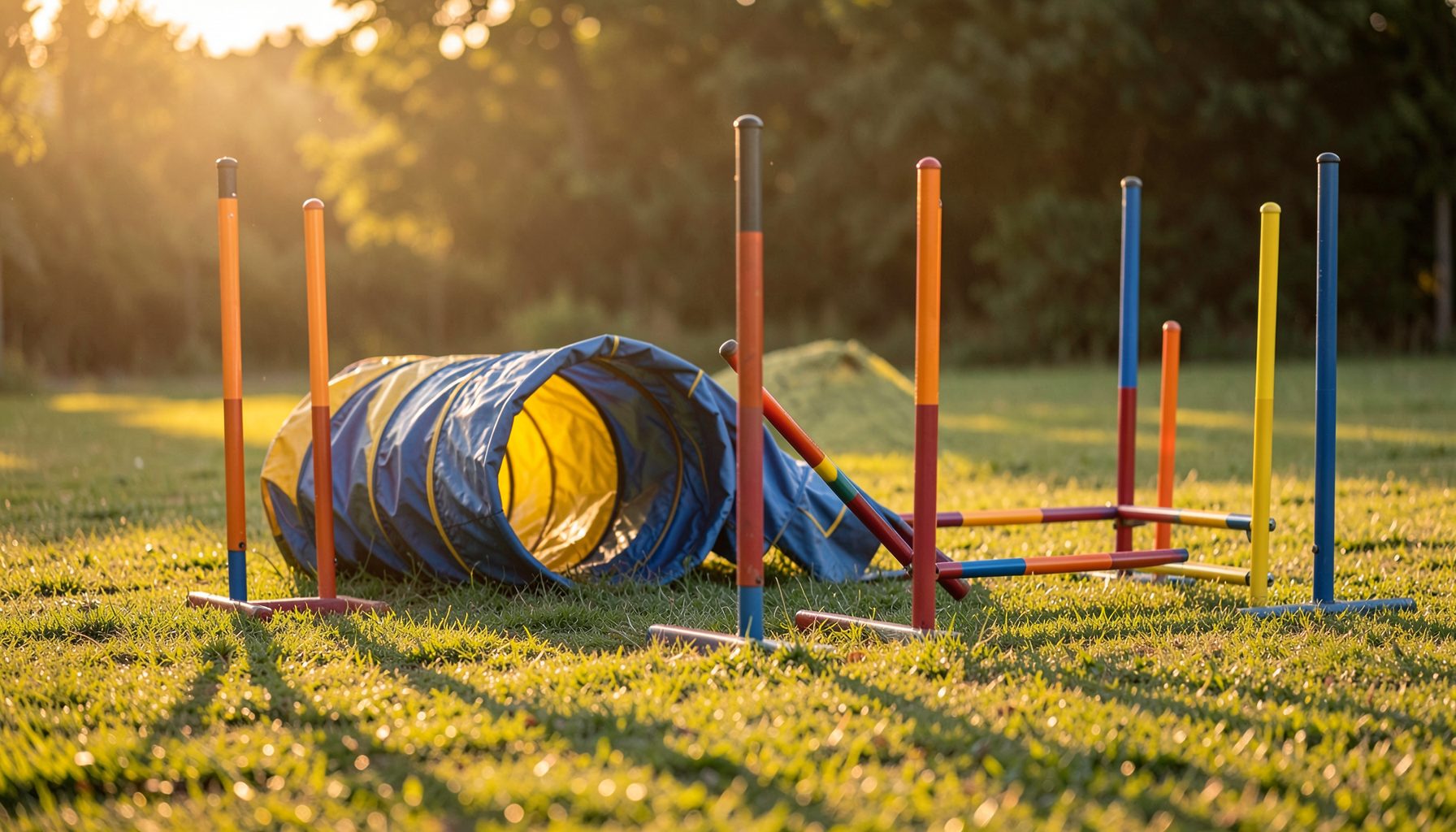
Holding the edit together when the light shifts mid-trial
Shooting dog agility means accepting that the sun will not cooperate. One minute the weave poles are glowing in clear winter light, the next minute a cloud bank has parked itself over the ring and the colour temperature has plunged twenty minutes into a Novice jumpers run. Editing those frames back at the desk, the goal is to keep the whole gallery reading like a single event, even when the light told a different story every fifteen minutes. Learn more about Privacy Policy.
The work happens long before the slider in Lightroom. Consistent editing under shifting light is really a question of what you do in the field to protect the files you will later colour-grade. Photographers working across multiple rings at the same trial, or jumping between clubs across the country, learn quickly that a tidy raw file is the only thing standing between a polished gallery and a patchwork quilt of mismatched whites.
Why outdoor light jumps around at Aussie trials
Australian trials have their own rhythm and their own weather quirks. A summer Saturday at a Sydney club can start harsh and blue by 9am, soften into milky overcast after the arvo tea break, then flare again as the sea breeze pushes the clouds back offshore. In regional Victoria, a wind change rolling off the ranges can swing exposure two stops in the time it takes a handler to set up at the start line. Brisbane events have their own pattern, where a sudden downpour sends everyone under the trestle tables and the light turns to flat, greenish-grey.
The angle of the sun matters too. The lower winter sun in Hobart or Adelaide throws long shadows across contact obstacles and catches dust kicked up by the dogs. In Darwin, the light goes warm and amber by 4pm and stays that way until the trial wraps. None of that is a problem for a handler chasing a clear round, but it creates headaches for a photographer trying to keep skin tones, eye colour, and ribbon colours believable from the first frame of the day to the last.
A lot of this variation is invisible to people standing ringside because the eye adapts beautifully. The camera does not. Knowing the conditions are going to change is half the battle, which is why any photographer worth their salt shows up with a plan for the inevitable swap.
Camera choices that hold the edit together
Consistency starts in the viewfinder, not in the develop module. Shooting raw is non-negotiable because it gives the latitude to recover shadows under bark mulch or pull highlights off a white sheltie coat without breaking the image into posterised blocks. Most of the time we work in manual mode during a single run, then re-evaluate before the next height class, because metering that worked at 10am will overexpose half an hour later when the cloud cover breaks.
White balance stays on a fixed Kelvin value rather than auto. Auto white balance tries to be helpful and ends up making every cloud passage a new colour cast. Setting a known value, even if it looks a touch warm or cool on the back of the camera, gives every frame of the day the same starting point. That single decision saves hours later when sorting through four hundred images from a National event.
A custom picture profile with reduced contrast and slightly lifted shadows also flattens the file enough to survive a harsh lighting swing without clipping. The trick is to underexpose by about a third of a stop so highlights stay safe, then bring the file back up in post. We follow this approach across every gallery we deliver through Pawprint Pictures, which keeps results steady from ring to ring and trial to trial.
A raw workflow that forgives changing exposure
Once the cards are dumped onto the editing desk, the workflow has to be just as disciplined as the shooting. Every trial is sorted into folders by ring, height, and judge, then colour-flagged by light condition. The gallery named for a single club show might end up with three batches: bright sun, broken shade, and the late arvo golden stuff. Each batch gets its own baseline adjustment before anything is unified.
The baseline adjustment is built around the same recipe every time. Exposure gets nudged to recover the ETTR files, whites are set using the white dog in the frame as a reference, and blacks sit just above clipping. Highlights and shadows are balanced so a black tri Australian Shepherd and a cream golden retriever both have detail across their coats. Only after that base is laid down do any local corrections go on.
For events where we are working across clubs and organisations like ANKC, UKI, and the local state bodies, the workflow becomes even more important. A working photographer keeps notes on each venue's light behaviour, which is why we share our approach in a cyno club photographer's field guide for anyone shooting in similar conditions. The notes become a personal cheat sheet that trims twenty minutes off every edit and keeps results consistent between a Dandenong trial in June and a Cairns carnival in November.
A colour grade that survives the swap
The grade itself is where the magic happens, and where many photographers quietly give up. The temptation is to copy a single preset across every frame and call it a day, but that ignores the reality of the light. A more reliable method is to anchor every image to a handful of neutral reference points: the green grass, the white ring tape, the handler's skin, the dog's nose. Those four anchors stay roughly the same regardless of whether the sun was out or hidden.
Skin tone usually does most of the heavy lifting. A handler's face should read true to life even if the rest of the frame is moody, because people look at faces first. We balance hue and saturation until the skin looks honest, then reach for the rest of the frame. The white ring tape acts as a built-in grey card for setting exposure and white balance, and the dog's nose confirms the overall cast is in the right zone.
When the day has gone through a major shift, such as a complete overcast turning to harsh midday sun between Standard and Jumpers, we will often split a gallery into two slightly different grades. The split is invisible to the buyer browsing the site, because each section is internally consistent and the transition happens between events rather than mid-run. The point is not to deny that the light changed, but to make the change feel intentional rather than careless.
Delivery, search, and keeping handlers happy
All this effort is wasted if the handler cannot find the photos easily. Galleries are organised by event, club, handler, and dog, and a search bar pulls up a frame within seconds when someone types in their kennel name or a dog's call name. That matters at a busy three-day event where handlers might shoot fifty runs and need to find one specific photo before the trophies are handed out.
Behind the scenes, every batch of files carries its own metadata so the support team can locate an image from a description. A customer who rings up saying their mate's border collie knocked a bar in run three can be matched to a folder without a long email chain. The goal is for the editing discipline to be invisible: every image looks like it was shot in the same light, even when the dog, the judge, and the weather all had other ideas.
A short checklist to keep handy on trial mornings:
- Set white balance to a fixed Kelvin value before the first run of the day
- Shoot raw with a flat picture profile, underexposing by a third of a stop
- Flag batches by light condition during the lunch break, not at 11pm
- Build the baseline grade around grass, ring tape, skin, and nose
- Re-evaluate exposure between height classes, not between dogs
Light will keep doing what it likes. The gallery, however, should never show it.