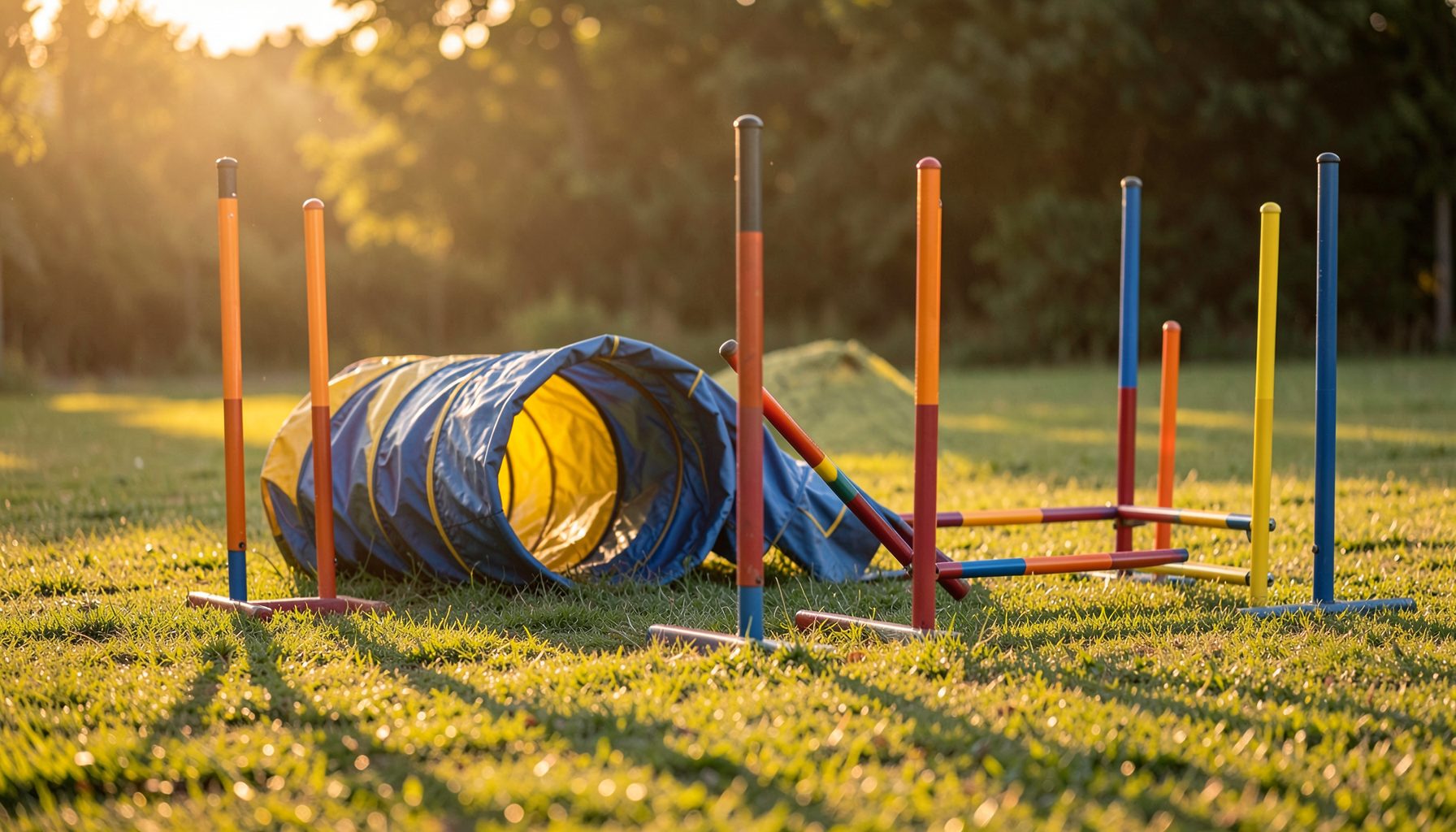
Why we love capturing a dog's front paw fold mid-jump
There's a particular hush over a photography station when a handler and dog line up at the start of an agility course in places like the Royal Melbourne Showgrounds. The crowd leans in, the dog vibrates with anticipation, and somewhere between the first obstacle and the finish line, a micro-moment happens that we wait for: the front paws folding beneath the chest as the dog launches over a jump. It's a detail most spectators miss in real time but one that freezes beautifully in a still image.
Photographing dog agility is about more than catching a dog in mid-air. It's about understanding the biomechanics of the jump—the way a Border Collie tucks its forelegs to clear a bar, or how a kelpie seems to fold in half to skim over a tire. We've spent years training our eyes to that exact frame, and the small thrill never fades.
The fold is captivating because of its brevity. The entire action—from gather to lift to fold to extension—happens in less than a quarter of a second. Capturing it well demands timing, gear knowledge, and familiarity with how different dogs move.
The anatomy of the fold
A dog's front paws don't hang loosely during a jump. As the dog approaches the obstacle, the hind legs gather power while the front legs lift and rotate inward, pulling the paws up and back toward the chest. This folding action reduces the body's frontal profile, allowing the dog to clear the obstacle with minimal clearance.
The fold looks different depending on the obstacle. A bar jump shows a sharp tuck as the dog pulls the front paws high to avoid knocking the bar. A tire jump requires a tighter fold because the aperture is smaller. A broad jump sees less folding and more extension, while a panel jump falls somewhere between.
| Obstacle type | Typical fold depth | Front paw position | Photographic appeal |
|---|---|---|---|
| Bar jump | Deep, high tuck | Paws pulled back toward chest, elbows bent | Crisp silhouette against sky, bar still in frame |
| Tire jump | Tightest fold | Paws nearly touch chin, body very compact | Strong circular framing through the tire |
| Broad jump | Shallow, extended | Front legs reach forward over panels | Sense of speed and length |
| Panel jump | Moderate | Paws tucked but body still elongated | Good balance of motion and form |
Reading these differences helps us position ourselves on the course. At a weekend trial hosted by an ANKC-affiliated club in Brisbane or Adelaide, you might see all four obstacles in a single run, each demanding a different angle.
Why this micro-moment matters
There's something deeply expressive about a dog in the moment of the fold. It captures concentration, athleticism, and trust between handler and dog. The eyes are forward, the ears are pinned, the body is committed. A great photograph freezes that commitment in a way that words or video can't.
Handlers often tell us they didn't know their dog looked like that. They've trained for hundreds of hours, but the fold happens so fast they've never actually seen it. When we show them a frame where the front paws are tucked cleanly, they're seeing their dog in a way they never have before. That's why so many handlers return to our Pawprint Pictures galleries after every event.
Coaches use these stills to break down a dog's technique, checking whether the fold is symmetrical, whether the dog is drifting, or whether the timing is off. A clean shot becomes a teaching tool, a memory, and sometimes marketing material for a handler's breeding program.
Timing the shutter
Catching the peak fold is about anticipation, not reaction. By the time the fold is visible in the viewfinder, it's already over. We watch the dog's path, the handler's cues, and the approach stride, firing a fraction of a second before the dog reaches the obstacle. With practice, the timing becomes instinctive.
We shoot in high-speed continuous mode at ten to twenty frames per second. The fold might appear fully in only one or two of those frames. The rest still show the gather, takeoff, or landing, but the peak fold is the money shot.
Australian conditions add a wrinkle. Many clubs schedule early morning starts in summer to avoid the heat, meaning low-angle light and dogs that are fresh and fast. Cool muscles and rising sun produce some of the cleanest folds of the year.
Camera settings that freeze the motion
Shutter speed is everything when freezing a fold that lasts milliseconds. We work at 1/2000s or faster, often pushing to 1/3200s in bright conditions. That speed eliminates motion blur in the paws and keeps the expression sharp. Anything slower risks a soft front leg.
Aperture and ISO support the shutter speed. In the harsh midday sun common at Queensland winter trials, we stop down to f/5.6 or f/8 and keep ISO at 200. Under canopy or in a Melbourne autumn morning, we open up to f/2.8 and push ISO to 1600 or 3200. Modern cameras handle high ISO cleanly.
Autofocus matters too. We use continuous AF with subject tracking, locking onto the dog's eye or the handler's hand. The fold is too brief for AF to acquire reliably, so we pre-focus at the jump location and trust the framing. A sturdy monopod stabilises the long lenses we carry.
Reading the course and the dog
Every course has a rhythm, and every dog has a style. Some handlers run tight and collected; others send wide and fast. A dog with a strong stride approaches a bar jump differently than a smaller dog who snaps into the fold early. Reading these patterns separates a good photo from a lucky one.
We walk the course before the trial, noting jump angles, lighting direction, and handling paths. In an indoor venue like the Dogs NSW Royal Canin Agility Spectacular, lighting is even but backgrounds can be cluttered. At an outdoor grass trial in Perth, backgrounds are cleaner but wind affects the trajectory.
Knowing the dog's history helps. A dog returning from injury might fold protectively, while a confident veteran launches with full extension. We keep notes on recurring dogs across events, positioning ourselves to capture each style at its best.
Working with Australian light
Light in Australia is intense and unforgiving. The UV is strong, the sun sits high, and the contrast between bright sky and shaded course elements can be extreme. Most Australian events run between late autumn and early spring, but summer trials still happen in Tasmania and southern Victoria where the heat is less brutal.
Backlighting can be magical if handled carefully. A low sun behind the jump turns the dog's outline into a glowing silhouette, and the fold becomes a dark shape against a bright sky. The trick is to expose for the highlights and let the dog fall into shadow, or use fill flash to recover detail.
Overcast skies, common in coastal cities like Sydney during spring, act as a giant softbox. The fold loses some crisp shadow definition but gains even illumination across the dog's body. We prefer overcast conditions for technical shots because every part of the dog is visible.
Sharing and ordering the final image
Once a great fold shot is captured and edited, the next step is getting it to the handler and dog owner. We upload galleries organised by event, club, handler name, and dog name, making it easy to find specific runs even at busy multi-ring weekends. Search functions let customers locate images by their dog's call name.
Customers browse their galleries and order prints, canvases, or digital downloads through a secure shopping cart. The site handles everything from single 6x4 prints to large wall pieces suitable for a training centre. For anyone curious about how their information is handled during checkout, the privacy practices are outlined clearly.
If you're heading to a trial soon, whether it's a local fun day in Geelong or a championship at Dogs Queensland, browse your gallery after the event and order the frame that makes you fall in love with your dog's athleticism all over again.