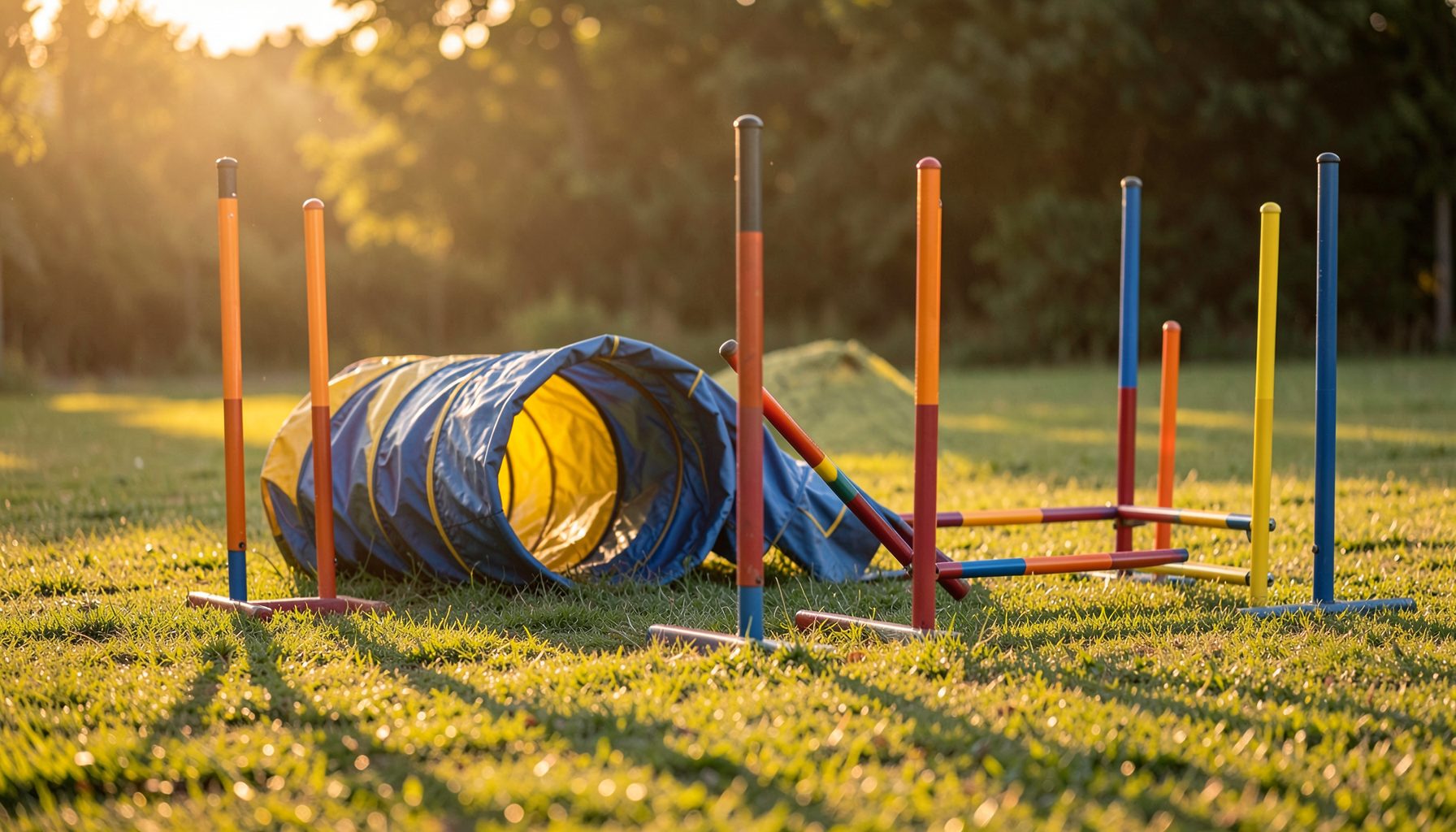
Why we always photograph the dog's tunnel exit as well as the entry
At any agility trial under the Australian sun, the tunnel tends to be one of the loudest obstacles on the course. Dogs barrel in with their ears back, owners hold their breath, and the whole crowd leans a fraction to one side as if they could push the dog along. Most photographers, us included, will frame the mouth where the dog disappears, but that's only half the picture. The other half happens a second or two later, on the far side, when the dog blasts out into the open.
We shoot the exit for the same reason a cricket photographer covers the batter's follow-through rather than just the cover drive. The peak of the action, the commitment of the handler, and the dog's full extension are all visible at the tunnel's far end. Skip that moment and you miss the shot that ends up framed above the lounge room.
Where the speed really happens
A dog enters a tunnel already moving, but the exit is where that movement turns into something visible to the lens. Coming out, the dog drops its head, pushes off with the hindquarters, and launches into a sprint. You get a stretched silhouette, sometimes a flying trot, often a slight airborne moment as the handler calls the next obstacle. That burst is over in a heartbeat, which is exactly why it needs a second camera or a second shooter positioned at the other side.
At a typical trial weekend at KCC Park in Cranbourne, dogs regularly reach speeds of around five metres a second through the longer tunnels. Anything slower than 1/1600 of a second and you'll get motion blur in the legs even when the body stays sharp. The exit frame is the one we still print most often, and customers return to buy it as a second image more than any other tunnel shot.
Light and background at each end
Outdoor agility venues in Australia present a particular problem: the sun sweeps across the ring during the day, and what looked like a clean backdrop at 9am becomes a blown-out glare by 2pm. We shoot both ends of the tunnel because we never know which side will give us better light, cleaner fences, or fewer sponsor banners cutting through the frame.
At a Sydney event at Castle Hill in the western suburbs, the morning light often picks out the tunnel entry beautifully, but by lunchtime the only usable background is the exit end, where a stand of eucalyptus breaks up the distant power lines. That kind of variety matters in a gallery. Customers searching by dog name want to see their dog from multiple angles, not five near-identical shots taken from one corner.
Handler reactions tell half the story
The tunnel exit is also where the handler's face does most of the work. By the time the dog enters, the handler is already planning three obstacles ahead. By the exit, the handler is reacting, often turning, sometimes clapping, occasionally shouting a praise word you wouldn't necessarily print in a polite magazine. That reaction is a big reason handlers come back to buy their own photos.
Australian handlers are an expressive bunch, especially at the larger Dogs Australia (formerly ANKC) sanctioned events where club culture is vocal and supportive. Capturing the teamwork moment, the eye contact between handler and dog as it bursts out, is something a tunnel entry shot simply can't deliver. We frame the exit so both faces are readable, and the partnership is the picture.
Technical demands of a tunnel mouth
Photographing a tunnel exit is harder than the entry for a few practical reasons. You don't know exactly where the dog will emerge, since tunnel bags shift slightly between runs and dogs sometimes skip a foot forward before they appear. We're shooting at f/4 or wider with a long lens, pre-focusing on a likely exit point, and panning as the dog clears the bag.
It also helps to shoot from a low angle, close to dog height, rather than the standing eye-level position most amateur photographers default to. The low angle exaggerates the dog's stride, hides the horizon line behind handler legs, and makes the dust kicked up at an outdoor trial glow in the late afternoon light. Our editing workflow for bringing out that dust and action is something we walk through on the blog.
How course design shapes our coverage
Australian agility courses are designed by judges accredited through Dogs Australia, and they tend to set tunnels in spots that challenge the handler as much as the dog. A common pattern places the tunnel exit directly in line with a weave pole entry, which means the dog's trajectory out of the bag decides whether the weaves are clean. We position ourselves to capture that decision point.
Because course designs differ between organisations, our gallery tags also differ. A weekend that mixes AKC, USDAA, NADAC, CPE, and ASCA runs in the same ring produces different photo opportunities, and the way we sort those into galleries reflects how each body structures its classes. Customers browsing our comparison of agility coverage can see what to expect at each kind of event.
Climate, regulations, and the Australian trial calendar
Local conditions shape what we shoot as much as the course does. Australian summers are brutal on outdoor trials, with heat policies under state welfare legislation, including the Prevention of Cruelty to Animals Acts in NSW and Victoria, requiring judges to halt running in extreme conditions. Dogs that are heat-stressed come out of tunnels more slowly and with less extension, and a photographer who only shoots the entry will miss the difference between a peak performance and a tired one.
Most state bodies, including Dogs NSW and Dogs Victoria, also require microchipping and current council registration before a dog can compete, and that pre-ring paperwork shows up in handler body language at the start line. We capture it all because the trial day is a complete story, and the exit frame is the chapter most people remember.
Building a searchable gallery customers actually use
All of this matters only if the photos can be found again. We organise every tunnel exit shot under the event, club, handler, and dog name, so a customer typing a kennel name or a handle into the search bar on our club shows and trials page gets to their image in seconds. The tunnel exit is often the thumbnail that hooks them first, then the entry shot closes the loop.
If a customer can't find their dog, our support team digs through the day's gallery and resends a download link. We never want a great exit shot to be the one that got away because it sat on a hard drive in the wrong folder.
The tunnel exit frame is the one most customers remember and the one they buy as a second image. A photographer who covers only the entry is giving their clients half the story and missing the moment the sport is actually about: the dog's commitment, the handler's relief, and the dust still settling behind them.