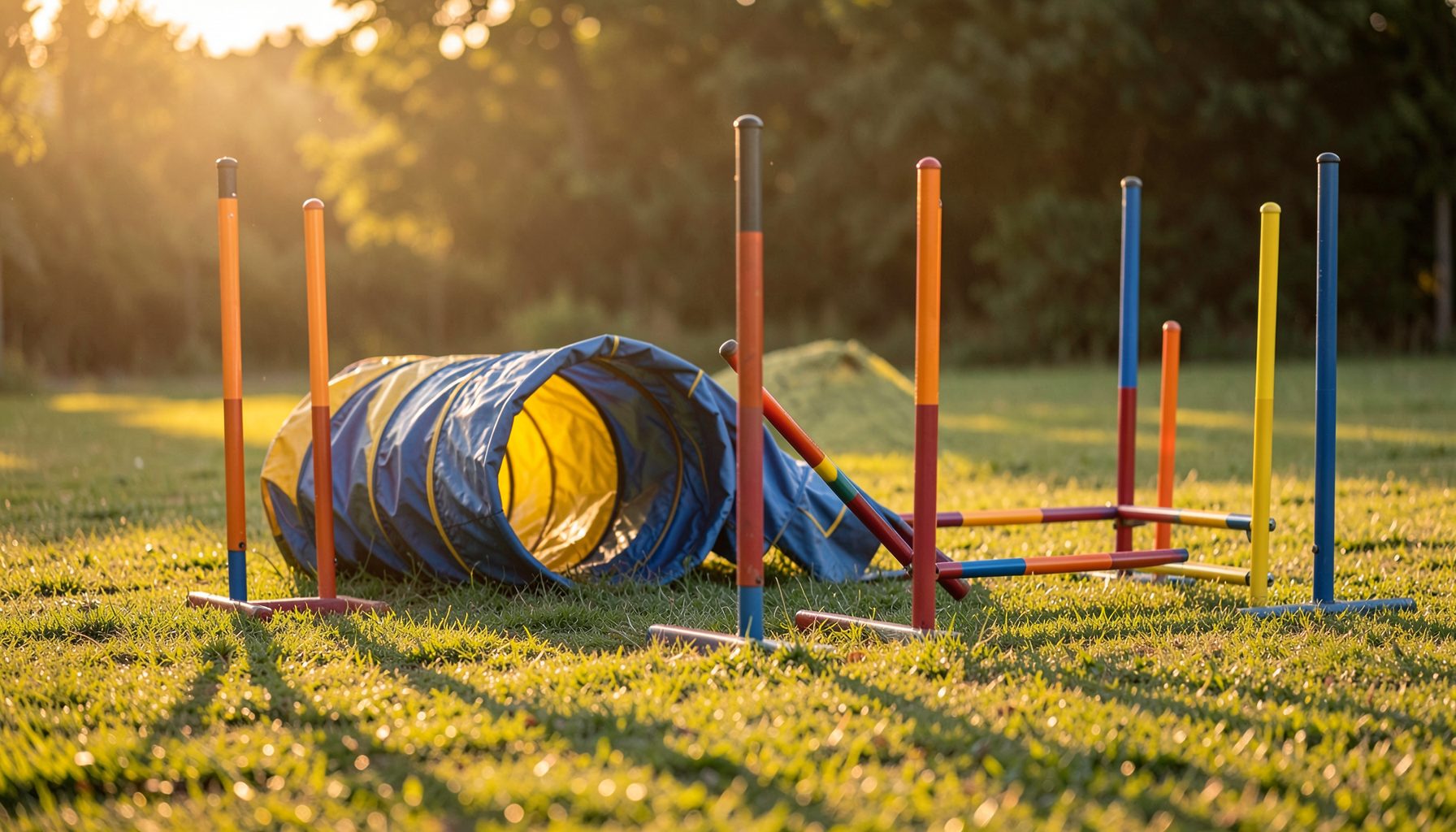
Why Every Dog’s Broad Jump Deserves Its Own Photograph
A broad jump can look like a simple obstacle: a dog launches from one side, clears a series of low boards and lands beyond them. In practice, each attempt reveals a different combination of stride length, confidence, speed, focus and communication between dog and handler. That variation is what makes the obstacle so rewarding to photograph.
At Pawprint Pictures, the aim is not to produce a generic action shot of “a dog jumping”. It is to capture the individual solution each competitor brings to the obstacle. A compact terrier may gather tightly and spring through the centre, while a tall, rangy dog may flatten into a long, efficient shape. Both approaches tell a real story about the partnership on course.
For Australian competitors travelling to weekend events in Sydney, Melbourne, Brisbane, Adelaide or smaller regional clubs, photographs also preserve the atmosphere of a particular day. They can bring back the early start, the dusty grounds, the familiar call of the ring steward and the satisfaction of a clean run long after the ribbons have been packed away.
The Broad Jump Is More Than A Clearance
The broad jump tests forward movement without offering the dog a vertical target to focus on. The correct line, take-off point and landing zone must be understood quickly. A dog can clear the obstacle successfully while using a very different rhythm from the competitor before it.
A photograph taken at the right fraction of a second shows those choices clearly. It may reveal a dog driving from the rear, stretching its front legs towards the landing, or tucking compactly because the handler has chosen a tighter line. The image becomes a record of technique rather than a random freeze-frame.
For owners, that distinction matters. An image can show why one attempt looked effortless and another appeared hesitant, even when both were judged as successful. It can also preserve progress as a young dog develops better timing and confidence across a season.
Timing Reveals Individual Style
Action photography depends on anticipating the moment rather than reacting after it has passed. At the broad jump, the most expressive frame may come just before take-off, at maximum extension or immediately after landing. Each point offers different information about the dog’s movement and concentration.
A Pawprint photographer watches the approach, the handler’s shoulder line, the dog’s head position and the spacing between the boards. This helps identify when the dog’s body is most naturally balanced. The result might show ears forward and eyes fixed on the next obstacle, or a powerful mid-air shape that conveys speed even in a still image.
The photograph also respects differences between breeds and training backgrounds. A Border Collie working at full pace may create a stretched silhouette, while a smaller dog may appear airborne for a shorter interval but show remarkable precision. Neither style needs to be made to look like the other.
What The Camera Looks For
A strong broad-jump photograph combines technical detail with emotion. The dog’s body should remain readable, the obstacle should provide context and the handler’s presence should help explain the line. These elements guide the selection of images for event galleries.
The photographer may pay particular attention to:
- The dog’s approach speed and stride pattern
- The take-off point in relation to the boards
- Ear position, eye focus and facial expression
- Full-body extension or a compact tucked shape
- The handler’s movement and direction
- The landing phase before the next obstacle
These details are especially useful when several dogs run through the same class. They prevent the collection from becoming a set of interchangeable jump images. Each frame should belong unmistakably to the dog and the run it records.
Images That Serve Competition Memories
An agility photograph is often purchased because it captures a personal milestone: a first qualifying score, a new title, a difficult surface handled well or a confident performance after a break. A broad jump may be the moment that best expresses that achievement, particularly when the dog’s whole body is suspended above the obstacle.
Pawprint Pictures organises images by event, club, handler and dog name, making it easier to locate photographs after a busy weekend. Competitors who remember only the venue or class can use event gallery search to narrow their options and review the available action shots.
This organisation suits Australian agility habits, where handlers may spend several hours at a Saturday or Sunday trial, move between rings and return home before sorting through results. Clear galleries reduce the need to remember an exact running order, especially when a club hosts multiple classes across a large grounds area.
Why Accurate Gallery Details Matter
Naming and sorting are part of preserving the photograph’s meaning. A dog may compete at several trials in the same month, while a club may host an annual event with a similar title each year. Distinguishing the organisation and event date helps owners find the correct run instead of browsing an indistinct collection.
The gallery naming approach reflects how competitors actually search. Someone in Perth, Canberra or the Gold Coast may remember the club first; someone else may recall the date, venue or trial weekend. Using both pieces of information creates a practical route back to the image.
It also supports clubs and handlers who share photographs online. A properly identified gallery is easier to reference in a training group, club newsletter or social media post, while the original context remains attached to the work. For Australian customers, secure online ordering and clearly identified photo products make it possible to arrange prints without relying on cash sales at a busy event.
Respecting Dogs, Handlers And The Event
Photographing agility requires awareness of the competition environment. The photographer must work from an approved position, avoid distracting dogs and handlers, and follow the instructions of the host club or event official. Broad-jump images are valuable only when they are made without interfering with the run.
Australian events also operate within wider expectations around privacy and responsible image use. The federal Privacy Act does not automatically make every photograph at a public sporting event private, but clubs can set their own policies and participants may have specific concerns. A professional service should follow event rules, handle customer information carefully and provide a clear way to discuss an image or order.
Dogs’ welfare remains central too. Heat can be a serious concern during summer trials in places such as Brisbane, Perth and inland New South Wales, while wet grounds can change footing and jumping confidence. The photograph should document the dog’s performance in its real conditions, not encourage unsafe repetition for the sake of a picture.
The Moment Worth Keeping
The best broad-jump image does not simply prove that the obstacle was cleared. It shows how that particular dog travelled through the space: powerful or delicate, stretched or tucked, certain or still learning. The handler’s body language, the obstacle’s shape and the dog’s expression combine to make the moment recognisable.
That is why Pawprint Pictures looks for individual movement rather than applying one visual formula to every competitor. A trial in Melbourne, a club show outside Newcastle or a training session near Adelaide may produce entirely different light, surfaces and backgrounds, yet the central purpose remains the same: to preserve the partnership in motion.
Years later, the image can bring back more than a result sheet. It can show the dog’s character, the training behind one clean effort and the unique approach that belonged to that team. What readers should remember is that every broad jump has its own story, and the right photograph makes that story visible.