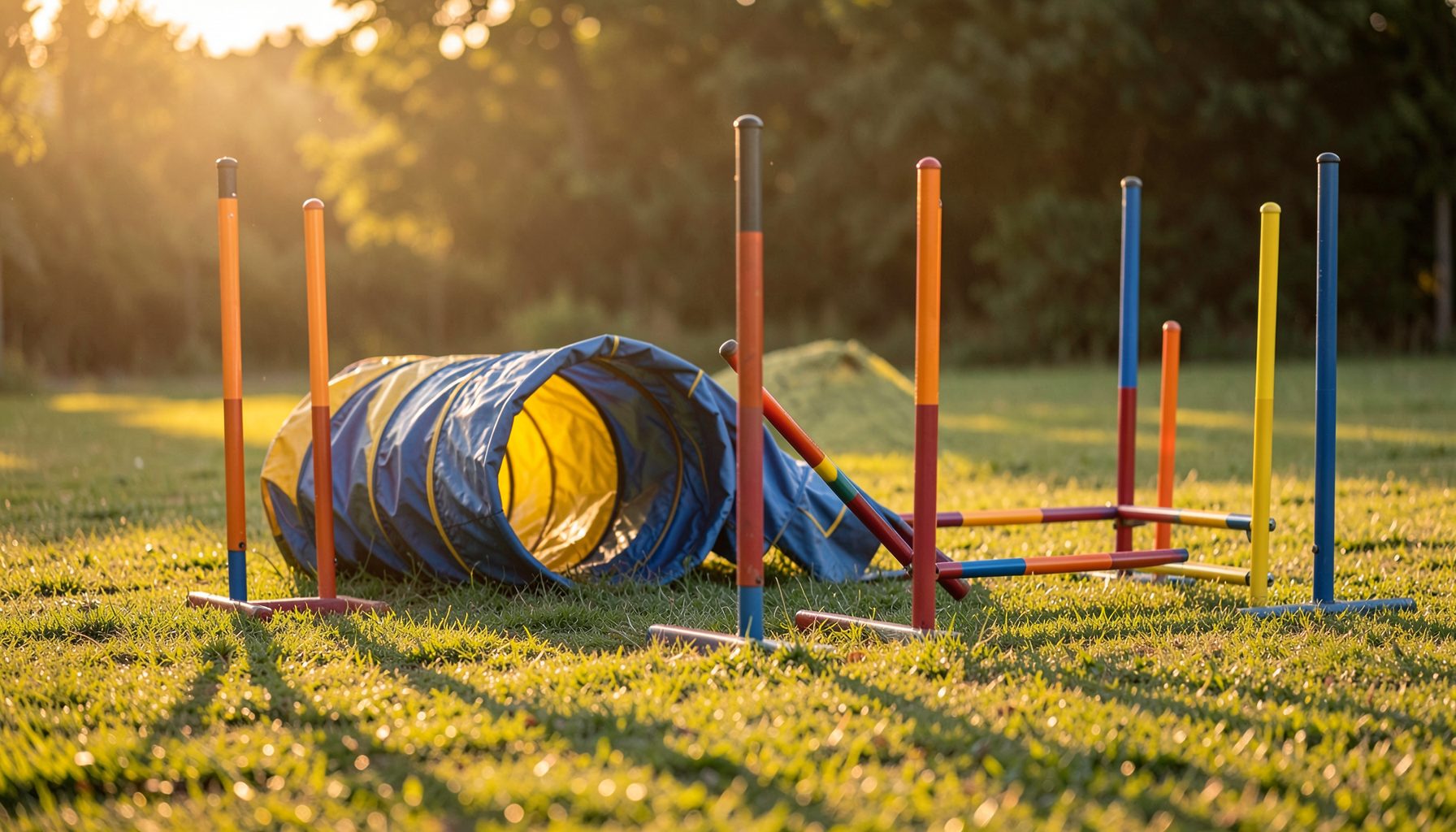
How to identify when your dog hits the yellow zone on the dogwalk
Spotting the instant when your dog's paw crosses onto the yellow contact area is a skill that separates casual spectators from serious agility observers. The dogwalk is one of the most photographed obstacles at trials in Sydney, Melbourne, Brisbane and Perth, and the yellow zone is where scoring, training and photo composition all hinge. Pawprint Pictures photographers spend weekends at Dogs Australia events held by clubs like the Agility Dog Club of NSW, knowing that missing the yellow moment means missing the story of the run.
Whether you are a handler refining your timing, a judge needing a second-by-second breakdown, or a photographer chasing that decisive frame, the cues can be learned. This guide walks through what the yellow zone really is, how the dog's body announces entry, and how to train your eye to catch it every time.
What the yellow zone actually means on a dogwalk
The dogwalk is a three-part obstacle: a ramp up, a flat elevated plank across, and a ramp down. The yellow zone is the painted section of the down ramp, usually the bottom twelve to eighteen inches, where at least one paw must touch for the contact to count. The colour is a visual aid for both dog and human, designed to give the dog a clear target and to give judges a defined region to watch.
Australian trials run primarily under Dogs Australia rules, which treat the down contact as the scored area in the same way as AKC and CPE rules. Many clubs around the country use the same equipment you see at international events, but the painted yellow strip can vary from school-bus yellow to a faded mustard on older gear. A low-contrast yellow on a grey plank in winter Hobart light behaves very differently from a vivid yellow under the Brisbane sun. Practising on your local club's equipment is the only reliable way to internalise how the colour reads in different weather.
Visual cues that mark the entry into the yellow
The first cue is the paw itself. Watch the leading front paw as it comes off the upper section of the down ramp. The moment that paw makes contact with the painted stripe, the shoulder will usually drop a few degrees and the head will lower to follow the descent. This is your visual marker for "yellow hit" in slow motion, and it is the same marker agility photographers chase with a fast shutter.
The second cue is the back paw's behaviour just after. On a correct two-on-two-off performance, both back paws stop square on the yellow. On a running contact, the back paws skim across the yellow without any visible pause. On a missed contact, the back paws land below the yellow line on the ground. The colour of the yellow stripe gives your eye a fixed reference point in all three cases.
Different performance styles change how the yellow moment looks.
| Performance style | Yellow contact cue | Visual signature | Where it is most often seen |
|---|---|---|---|
| Two-on-two-off | Both back paws stop square on yellow | Clear pause, hips square | Dogs Australia agility and obedience trials, foundation classes |
| Running contact | Back paws skim across yellow without stopping | Continuous motion, slight blur | Speed-focused clubs in Melbourne and Brisbane |
| Stopped contact with recall | Front paw plants on yellow, dog turns to handler | Planted touch, head rotates | Junior handler events, training matches |
| Missed contact | Yellow zone un-touched, paws land below | Paw lands on ground past yellow line | New handlers, foundation classes |
| Stretched running | Yellow touched briefly mid-stride, no pause | Single frame of contact, fast blur | Open and excellent classes at major shows |
How approach speed changes the moment
Stride length is the silent giveaway. A dog approaching the dogwalk at full extension will cover the last part of the ramp in a single bound, so the yellow moment will happen in the air before the paw lands. Reading approach speed requires you to watch the takeoff point on the flat plank, not the down ramp itself.
Australian venues tend to be open-air, which means wind and sun glare can affect how confidently a dog commits. At a summer trial in Darwin, a Labrador Retriever might slip into a measured approach on a hot plank, making the yellow contact longer and more visible. At a winter trial in Ballarat, the same dog might fly through with full speed, and the yellow contact will be a flicker. Photographers working under these conditions often pre-focus on the yellow zone and let the shutter release on a continuous burst. The article on a day behind the lens explains how that visual pre-loading works in practice.
Common mistakes when judging the yellow moment
The biggest mistake is watching the dog rather than the contact. Handlers frequently glance at their dog's face for confirmation, which means they look away from the painted strip at the moment it matters most. Train yourself to keep your eyes on the yellow zone and use peripheral vision to track the dog's body, the same trick judges use when they need to score dozens of runs in a day.
Another mistake is counting strides. Three strides from the plank end is a useful training guideline, but in a trial ring with distractions, the count will drift. Instead, watch for the dog's hips dropping as it crosses from the flat plank onto the down ramp, since that hip drop lines up with the paw's approach to the yellow zone and is far more reliable than any step count. A third mistake is confusing the entry contact with the exit, since some clubs mark both ends of the dogwalk with yellow paint. In a crowded ring at a Sydney Royal Easter Show demonstration, it is easy to track the wrong obstacle.
Reading the moment from judge and photographer viewpoints
Judges and photographers want the same frame but score it differently. A judge needs the moment to confirm a clean contact, looking for any paw on the yellow at any point. A photographer needs the front paw just touching the yellow while the back paws are still on the plank. In Australia, judges at Dogs Australia trials score from a fixed position beside the obstacle for a straight-on view, while photographers are often at a low side angle that compresses the yellow visually and makes the moment harder to read.
Catching the yellow moment in a still image comes down to shutter speed and burst rate. A shutter speed of at least one-thousandth of a second freezes a paw mid-stride, while a continuous burst of ten frames per second gives several options of the contact. Pre-focusing on the yellow zone with manual or single-point autofocus keeps the image sharp regardless of the dog's speed. Australian light can be unforgiving: midday sun at a Gold Coast trial creates harsh shadows that swallow the yellow strip, while overcast skies in Melbourne give soft, even light that flatters the colour. The post-run joy in photos piece shows how that split-second timing becomes a photograph that captures both contact accuracy and a dog's emotional release.
Training your eye between competitions
The fastest way to sharpen your yellow recognition is to watch runs without handling or photographing. Pick a local trial, sit ringside, and spend an entire day only tracking the yellow zone on every dogwalk. After twenty runs, your eye will start to anticipate the paw landing before it happens.
Australian clubs are particularly good for this kind of focused observation because the trial calendar runs almost year-round. A weekend in Perth, a midweek training match in Brisbane, and a championship event in regional Victoria all offer different lighting, equipment, and handling styles. Watching skilled handlers can fast-track your learning. The article on Australia's most photographed handlers breaks down how they approach the dogwalk and where their dogs typically make contact, which can sharpen your predictions.
Practical habits for spotting the yellow moment
A short list of habits that will sharpen your recognition of the yellow zone on the dogwalk, suitable for handlers, judges and photographers alike.
- Watch the leading front paw, not the dog's face, in the final two strides before the down ramp.
- Use the dog's hip drop as your secondary cue, since it lines up with the paw approaching the yellow.
- Avoid counting strides and rely on visual landmarks instead, especially at trials with wind or sun glare.
- Practise in all weather, because Australian summers and winters change how the yellow stripe reads visually.
- Pre-focus your camera on the yellow zone before the dog commits, so your shutter timing is the only variable left.
- Sit in different positions around the ring across several trials, to learn the moment from both judge and photographer angles.
- Study runs from skilled handlers, since their consistency makes the yellow moment easier to predict.
The single detail worth carrying forward is simple: keep your eyes on the yellow, and the moment will announce itself. A clean contact on a dogwalk is rarely a surprise to the handler or photographer who has trained themselves to watch the right place. Standing ringside at a Sydney trial, reviewing video at a Melbourne training night, or chasing that decisive frame for a Pawprint Pictures gallery, the discipline of watching the painted stripe rather than the dog is what makes the difference between guessing and knowing.