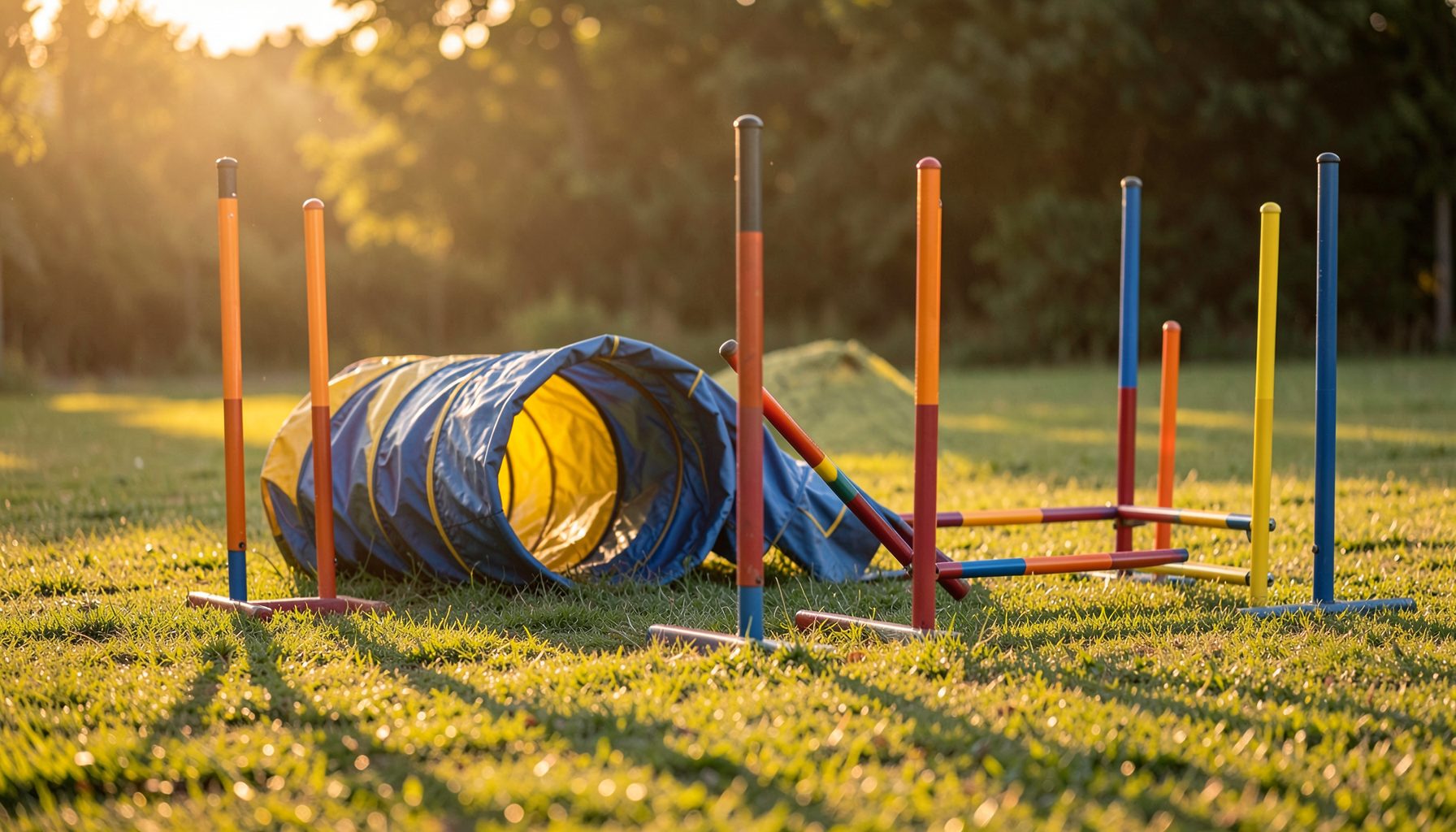
Shooting Clean Photos Through Fences at Outdoor Agility Trials
Australian agility weekends have a particular rhythm to them. You load the ute before sunrise, chuck the esky in the back with plenty of water, and head out to grounds like KCC Park or the Hills complex where the rings are already being set up. The light by eight in the morning is already biting, the dust is starting to rise from the car park, and the first handlers are warming up their dogs along the fence line. For a photographer, that fence line is both a blessing and a headache. It keeps the dogs safely inside the ring, but it also sits stubbornly between your camera and every jumping, weaving, flying dog you are trying to capture.
Over years of shooting trials run under Dogs Australia and the various state bodies, the team at Pawprint Pictures has developed a workflow that turns that wire and mesh into something you barely notice in the final image. It combines lens choice, ring positioning, a reading of the local weather, and a careful edit afterwards. None of it is glamorous, but together it is the difference between a gallery full of saleable prints and a hard drive full of soft shots you cannot use.
The reality of fencing at Australian trials
Most outdoor rings are bordered by chain mesh or weldmesh panels held up on temporary posts, and the gauge varies wildly from venue to venue. Some clubs use the dark green plastic-coated stuff that blends reasonably well with the background. Others use galvanised wire that catches every stray sunbeam and throws it straight back into your lens. The height is usually around one metre, which is fine for dogs but puts the wire right across your shot at dog level. Understanding exactly what you are shooting through is the first step, because the solution changes depending on whether you are dealing with fine chicken wire, a heavier diamond mesh, or one of those portable ring panels with a top rail.
Australian conditions add their own twist. A summer trial at places like the Dogs NSW grounds or a weekend at the Royal Melbourne Show often means heat shimmer rising off the sand, red dust clinging to everything, and grass that has been trampled to dust by lunchtime. The mesh catches that dust too, which is why a soft brush or blower becomes part of the camera kit on a long day. Even on a milder arvo in autumn, the light can be deceptively contrasty, and that contrast makes the wire far more visible in the final frame.
Choosing lenses and aperture settings
A long focal length is a photographer's best friend when shooting through barriers, because a tight crop lets the wire fall outside the frame entirely. Most ring-side shooters settle on a 300mm or 400mm prime, or a 70-200mm with a teleconverter, as their workhorse. The longer the lens, the more the dog and handler are isolated, and the more the fence simply becomes a thin line that sits above or below the action rather than across the face.
Wide apertures are tempting because they throw backgrounds into a creamy blur, but they also reduce the depth of field so much that a dog moving at full speed can drift in and out of focus mid-jump. Shooting around f/4 to f/5.6 gives enough subject isolation to soften the mesh while keeping the dog sharp from nose to tail. Stopping down to f/8 will make the wire vanish into a softer texture, useful when the angle is not ideal, but it costs shutter speed, which matters more when a cattle dog is hammering down the contacts.
Positioning around the ring
The single biggest improvement any photographer can make is to get off the centre line. Standing directly behind the mesh, square to the obstacle, is where the fence does the most damage to an image. Walking twenty or thirty metres down the side of the ring lets the camera shoot at an angle, where the wire recedes into the distance rather than sitting flat across the lens. That angle also catches the dog in profile across the weaves or the dog walk, which is usually the more flattering shot anyway.
Shooting from a lower position is another simple trick. Crouching down or kneeling puts the lens below the top rail of the mesh, and if the dog is mid-jump its body often clears the fence line entirely. A beanbag or a small ground pod is worth carrying for the bigger rings, because lying flat and shooting upward through the gap between the bottom of the mesh and the grass delivers images with none of that crossed-wire look.
Working with harsh Aussie sun
The Australian sun is famously unforgiving, and it has a nasty habit of bouncing off the wire straight into the lens. A lens hood helps, but a polariser is the real workhorse here. Rotate it until the glare on the mesh drops away, and the shot becomes noticeably cleaner. Just remember that a polariser also darkens blue skies and can affect the colour of grass, so it pays to dial it in carefully for each new angle.
On overcast days the wire nearly disappears on its own, which is one reason many experienced shooters quietly prefer the clouds. The flat light is kinder to dark coats and brindles as well. When the forecast turns grim, our rainy-day photography tips cover the gear swaps and settings that keep the camera working through a proper Melbourne downpour or a Brisbane summer storm.
Editing out the wire and mesh
Even with perfect positioning and a polariser, there will always be shots where a strand of wire crosses a dog's eye or a handler's hand. That is where a careful edit finishes the job. A healing brush or clone stamp on a raw file, worked in at one-to-one zoom, removes the stray strands in a few minutes per image. The trick is to clone from areas with similar tone and texture, which is easier when the background is out-of-focus grass or sand rather than a busy crowd.
Across a whole event gallery of several hundred images, those few minutes add up. Editors work through images in batches using consistent brush sizes and sampling points so the whole set looks uniform. The aim is for the wire to vanish without leaving the telltale smudges that give away a heavy edit, especially on the larger prints that handlers often order for the lounge room wall.
Staying polite at the ringside
A long lens tempts a photographer to push to the front of the ring, but staying aware of the people around is part of the job. Handlers paying good money to run their dogs do not want a camera bag blocking their view of the contacts, and judges do not appreciate flash going off near a sensitive dog. The full rundown of expected behaviour lives in our piece on the etiquette of ringside photography, which is worth a read before the first trial weekend.
A quick wave and a "g'day, mind if I shoot from here?" goes a long way. Most handlers are chuffed to see a camera pointed at their dog and will happily shift to give a cleaner line. They will also share which side their dog runs fastest, and that little bit of inside knowledge often makes the difference between a sharp shot and a wing-and-a-prayer.
Practical adjustments that make the biggest difference
- Carry a long lens of 300mm or more and stay at f/4 to f/5.6 for the best balance of sharpness and background blur
- Shoot at an angle rather than square to the ring, so the mesh recedes instead of crossing the frame
- Drop to a low position, either kneeling or lying flat, to push the wire below the dog's body line
- Fit a polariser and rotate it to kill the glare bouncing off the galvanised wire
- Edit in batches with a healing brush, cloning from clean areas of similar tone to keep the work invisible
- Pack a blower or soft brush to keep red dust off the front element between rings
Every trial weekend leaves a stack of frames that would have been unusable years ago, and most of that progress comes from the unglamorous bits: choosing the right aperture, finding the angle, brushing the dust off the lens. The dogs do not care about any of it, of course. They just want to run, and the better the image, the longer that one perfect moment survives on someone's wall. When it is a handler's very first trial with a young dog, those shots take on an extra meaning, which is why ideas for celebrating a dog's first trial often pair so well with a clean gallery image. There is something quietly satisfying about delivering a wire-free print of a border collie mid-weave to a handler who has chased that run for years, and that is what keeps the camera pointed through the fence long after the arvo has cooled off.