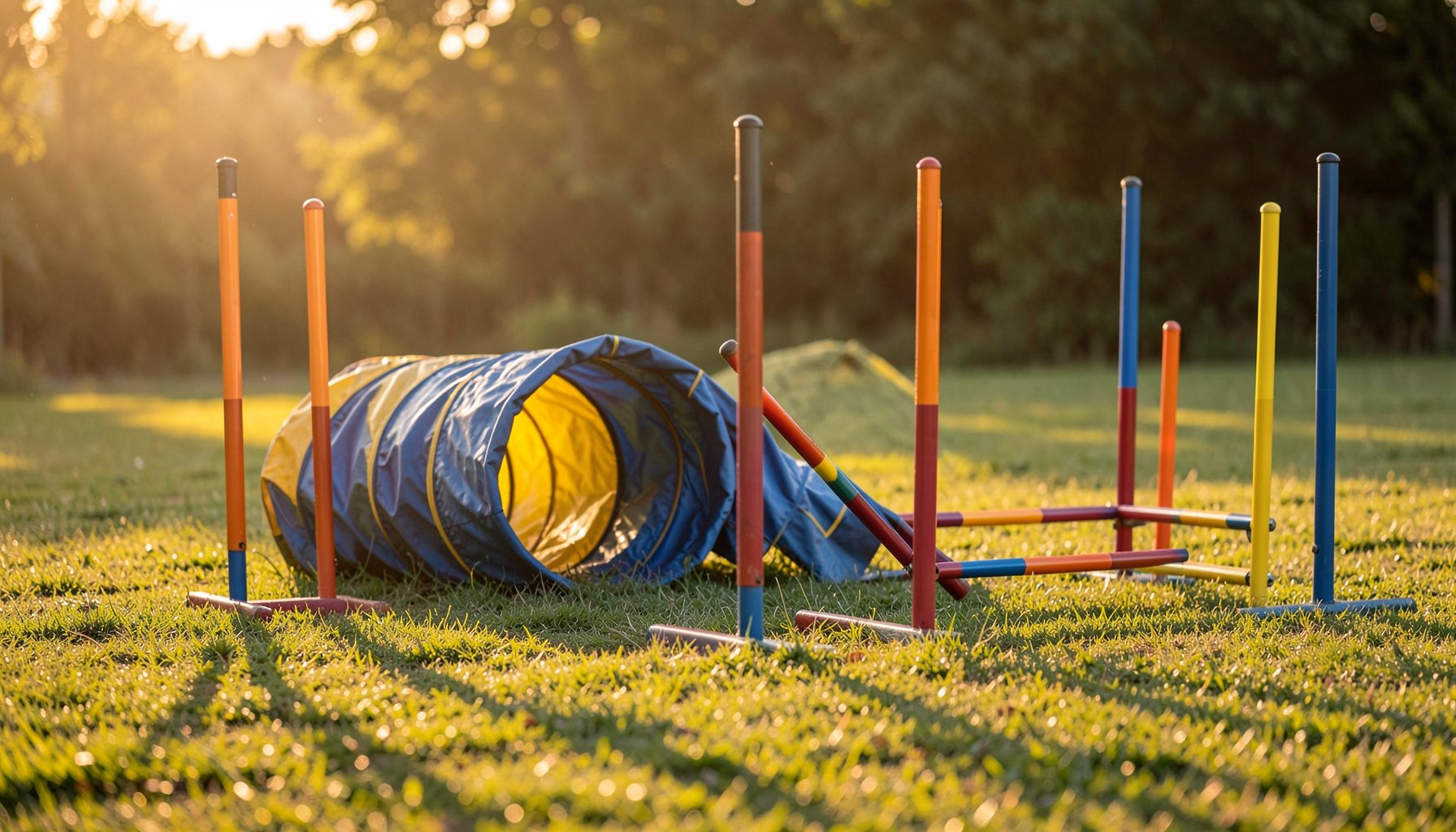
Why judges value clear dog walk paw photos
Judging dog agility depends on seeing how a dog leaves the start, travels over an obstacle and negotiates its marked zone without a run-out. What makes a photo of a dog’s paws on the yellow zone of the dog walk valuable for judges is its ability to preserve fleeting evidence of paw placement, balance and control.
A still photograph does not replace live observation, video or the judge’s score sheet. Its value comes from recording the right instant from a useful angle, with enough context to connect the image to the run, dog, handler, course and any decision under review.
What the yellow zone can show
The dog walk is an A-frame obstacle, and the yellow paint identifies the area used to judge foot contact. Its position, width and name vary with the governing rule set, so a photograph becomes more useful when it shows the whole marked area rather than only a tight crop of toes.
For a judge, a clear frame can show whether a paw landed beside, on or beyond the yellow zone, how the dog turned its foot after landing, and whether the body was already rotating away. That detail helps explain a run-out, a wide straddle or a tight landing, although the acceptance rules remain those of the event.
The photograph is strongest when the paws, yellow paint and direction of travel appear together. A head-on image may make a safe landing look narrow, while a distant side view may hide a toe just outside the line. Scale, lens distortion and the instant of exposure can therefore change the apparent story.
For small breeds, framing is harder because paw-to-body scale changes so quickly over an A-frame. The small-breed obstacle tips offer practical ways to preserve the obstacle context without losing the contact area in the background.
Timing and viewpoint shape the evidence
A side-on camera position records the landing arc, while a low three-quarter angle can clarify the leading paw and its distance from the yellow zone. A photographer working quickly should prioritise one decisive frame, then collect the approach, leave and landing as a short sequence rather than rely on a single image.
Useful supporting images also preserve spatial references such as the frame, slope, course side and nearby obstacles. Without them, a judge cannot tell which part of the dog walk is shown, especially on a course with several A-frames or when yellow markings are washed out by glare.
Any sign of persistent paw irritation should be treated as a welfare issue rather than a judging clue. Fleas and ticks can affect comfort and concentration, so owners should keep prevention current; this general article on flea and tick prevention offers background, while an Australian vet should recommend products suited to local parasites.
A judge-ready photo checklist
A credible dog-walk image should answer a narrow question without claiming to show the entire performance. Two well-timed views, supported by basic context, are usually more useful than a large gallery of indistinct photographs.
The frame should show:
- The landing instant, with the leading and trailing paws visible against the yellow paint.
- Foot position at entry or exit, without cropping away the marked boundary.
- Body alignment, stride and any turn of the paw after contact.
- The approach and leave, giving the judge a view of speed and balance.
- A wider view showing the A-frame, direction of travel and course surface.
The supporting record should contain:
- Event, date, course and obstacle number.
- Dog and handler identifiers used by the event records.
- The judge’s call, run number and relevant video timestamp.
- Camera position, frame number and whether the image has been cropped.
- The original file, kept unedited alongside any web or print copy.
One image cannot establish intent, the dog’s whole movement or an official result. A formal challenge is normally resolved from the judge’s direct observation, approved video and scoring records; photography is supplementary evidence and a valuable teaching aid when those sources are unavailable or inconclusive.
Turning an event gallery into useful evidence
The practical step is to find the run before ordering anything. The customer galleries provide an event-based route into collections organised by club, handler and dog, so a handler can move from a competition result to the matching obstacle sequence rather than searching through unrelated images.
At the same time, a commercial gallery image may have been resized for display. If an incident matters, request the original frame, the neighbouring frames and the metadata that identifies the run. Judges should receive copies in context, not a single social-media image selected after the result is known.
Prints and photo products are useful for handlers reviewing a performance at home, but an attractive crop is not automatically the strongest evidence. The best purchase is the frame that answers the judging question, supported by orientation and sequence. Ordering through a secure cart, with clear file specifications and delivery terms, is as important as image quality.
What Australian handlers should remember
For Australian handlers, usefulness starts with local conditions. Melbourne’s changeable weather, Brisbane’s heat and strong summer sun in Sydney, Adelaide and Perth can affect footing, paint glare and camera exposure. Courses may sit on grass, sand or synthetic turf, and many dogs warm up in suburban parks before travelling to a metropolitan venue or regional showground.
Everyday training habits shape the photographs too: owners often rehearse jumps in backyards, use fenced dog parks and carry portable equipment to club grounds. State agility clubs and the Agility Club of Australia provide familiar competitive settings, sometimes using international rule sets. Online galleries and print products fit the Australian pet-photo market, where buyers commonly expect prices in Australian dollars, clear GST treatment and a straightforward delivery process.
For buyers seeking that searchable record, Pawprint Pictures organises photography around events, clubs, handlers and dogs. Australian buyers should check the seller’s terms and keep receipts: the Australian Consumer Law provides consumer guarantees when its legal thresholds are met, while the Privacy Act 1988 may apply to identifiable customer records and copyright rules affect commercial reuse. Public attendance at an event is not blanket consent for commercial publication.
Ultimately, the image worth keeping is the one that shows the paw, the yellow zone and the motion in the same readable frame. It can support a fair, informed review without pretending that one photograph can tell the whole run.